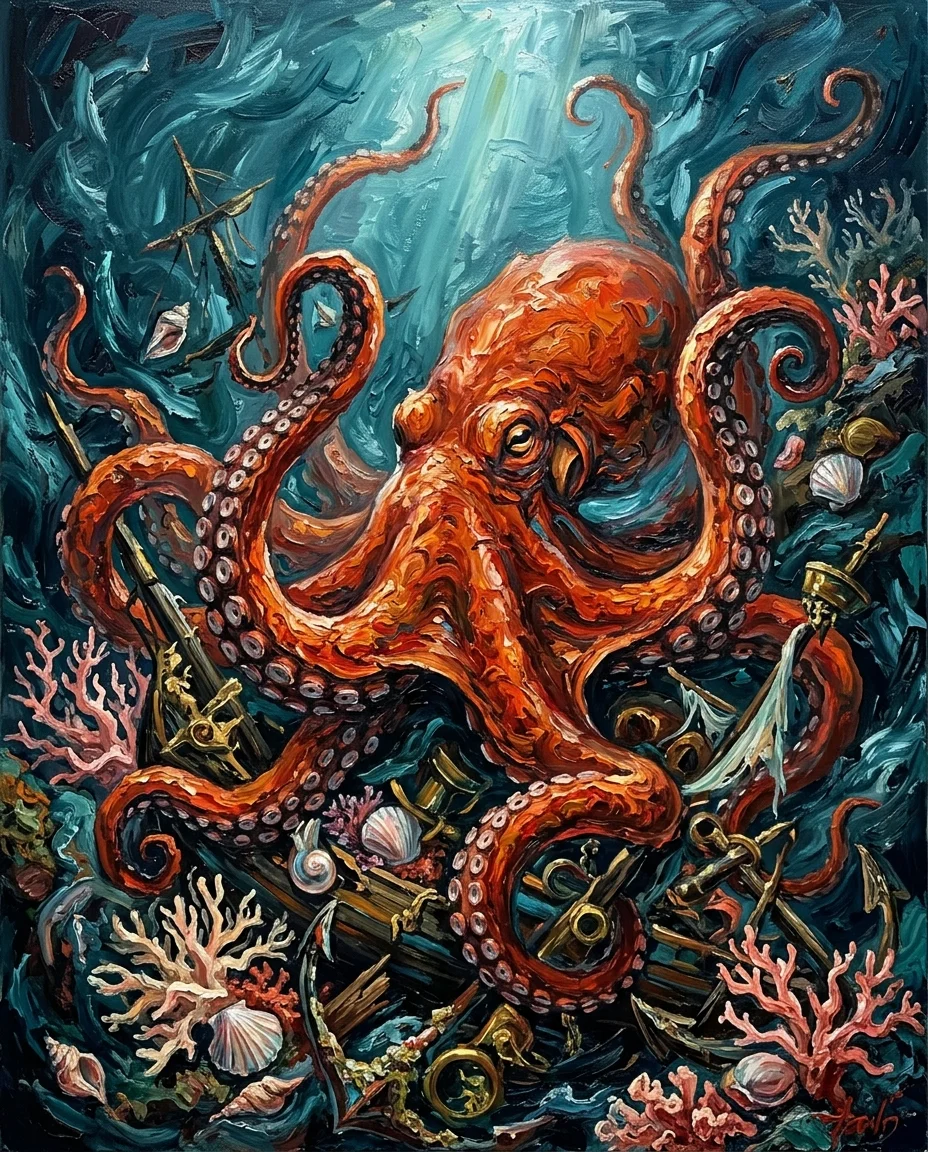
لوحة زيتية انطباعية فوضوية لأخطبوط في أعماق البحار
تضم هذه المجموعة البصرية 7 برومبتات مستقلة تستند إلى التوجّه الإبداعي نفسه للصورة الرئيسية. يمكنك نسخ أي برومبت واستخدامه بمفرده، أو استخدام المجموعة كاملة لإنشاء سلسلة بصرية متناسقة.
A chaotic, highly detailed oil painting depicting a vibrant vermilion-orange octopus filling the entire frame, its massive body centrally positioned with curling tentacles reaching outward in every direction toward the edges of the canvas and toward the viewer. The tentacles are entangled with branching coral formations in pale rose and ivory, scattered seashells with pearlescent inner surfaces, and fragments of aged shipwreck debris — splintered dark timber planks, corroded brass fittings, and torn canvas sailcloth. Dynamic thick brushstrokes surge across the canvas in swirling patterns suggesting powerful turbulent underwater currents. The color palette creates dramatic contrast between deep teal-blue of cold ocean water — darkening to near-black in the corners — and the warm orange tones of the octopus itself, shifting from bright vermilion on the mantle to burnt sienna along the sucker-lined undersides of each arm. The paint application is heavy textured impasto throughout, with visible ridges of pigment catching light along every brushstroke, thick palette knife marks defining the rocky substrate, and layered glazes creating translucent depth in the water. A single shaft of pale blue-green light filters from directly above, creating a dramatic spotlight on the octopus's mantle while leaving the tentacle tips and surrounding depths in rich velvety darkness. Moody chiaroscuro illumination. --ar 4:5
كل البرومبتات في هذه المجموعة
لوحة زيتية فوضوية مفصلة للغاية تصور أخطبوطاً نابضاً بالحياة بلون برتقالي قرمزي يملأ الإطار بالكامل، جسمه الضخم في المنتصف...
A chaotic, highly detailed oil painting depicting a vibrant vermilion-orange octopus filling the entire frame, its massive body centrally positioned with curling tentacles reaching outward in every direction toward the edges of the canvas and toward the viewer. The tentacles are entangled with branching coral formations in pale rose and ivory, scattered seashells with pearlescent inner surfaces, and fragments of aged shipwreck debris — splintered dark timber planks, corroded brass fittings, and torn canvas sailcloth. Dynamic thick brushstrokes surge across the canvas in swirling patterns suggesting powerful turbulent underwater currents. The color palette creates dramatic contrast between deep teal-blue of cold ocean water — darkening to near-black in the corners — and the warm orange tones of the octopus itself, shifting from bright vermilion on the mantle to burnt sienna along the sucker-lined undersides of each arm. The paint application is heavy textured impasto throughout, with visible ridges of pigment catching light along every brushstroke, thick palette knife marks defining the rocky substrate, and layered glazes creating translucent depth in the water. A single shaft of pale blue-green light filters from directly above, creating a dramatic spotlight on the octopus's mantle while leaving the tentacle tips and surrounding depths in rich velvety darkness. Moody chiaroscuro illumination. --ar 4:5
لوحة زيتية فوضوية مفصلة للغاية بتكوين واسع تظهر الأخطبوط النابض بالحياة بلون برتقالي قرمزي ممتداً عبر صخور واسعة...
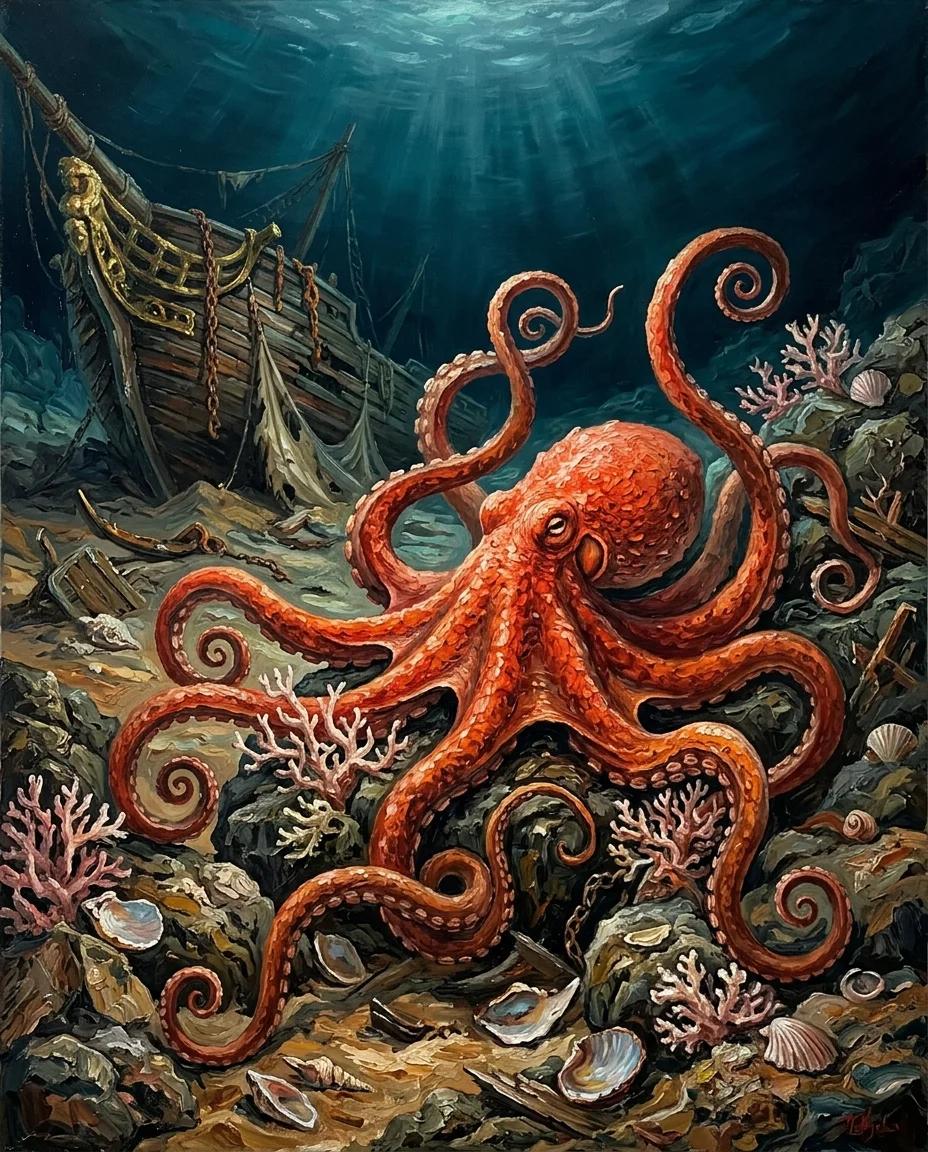
A chaotic, highly detailed oil painting with a wide composition showing the vibrant vermilion-orange octopus sprawling across a vast rocky sea floor, its massive curling tentacles extending to fill the width of the canvas. The octopus sits lower in the frame, claiming the rocky substrate as its domain, tentacles twisting and spiraling outward in every direction. They are entangled with branching coral formations in pale rose and ivory growing from crevices between boulders, scattered seashells of various sizes with pearlescent inner surfaces wedged into the sand, and fragments of aged shipwreck debris — a large section of hull with splintered dark timber planks rising from the left background, corroded brass fittings and chain links draped over rocks, torn canvas sailcloth half-buried in sediment. The full sea floor environment is rendered with thick impasto brushwork — the rocky terrain built from heavy palette knife marks in grey-brown and dark olive, the sand in ochre and raw sienna. Deep teal-blue cold ocean water fills the upper portion of the frame, darkening to near-black at the top. The octopus shifts from bright vermilion on the mantle to burnt sienna on the tentacle undersides. Multiple shafts of pale blue-green light filter from the surface far above, creating dappled illumination across the scene, leaving deep crevices and far areas in velvety darkness. Heavy impasto throughout. --ar 4:5
لوحة زيتية فوضوية مفصلة للغاية كلقطة مقربة للغاية لعين الأخطبوط ووشاحه المحيط، تملأ الإطار...
A chaotic, highly detailed oil painting as an extreme close-up on the octopus's eye and surrounding mantle, filling the frame with the creature's mesmerizing alien gaze. The octopus eye dominates the center — a horizontal slit pupil in deep amber surrounded by a complex iris of burnt orange and gold, the eye itself rendered with careful layered glazes that create a wet luminous depth contrasting against the heavy impasto of the surrounding skin. The mantle surface around the eye is a topography of thick impasto paint — ridges and valleys of vermilion-orange pigment applied with palette knife and heavy brush, the texture so pronounced it casts its own micro-shadows. Tiny suction cups at the base of a nearby tentacle are individually rendered as small concentric circles of burnt sienna and ochre. A single branching coral formation in pale rose encroaches from one edge of the frame, its delicate structure contrasting against the massive organic bulk of the octopus. The deep teal-blue water is visible only at the frame edges, the cold dark blue creating a dramatic backdrop for the warm orange flesh. A shaft of pale blue-green light catches the surface of the eye and creates a bright specular highlight. The paint texture is extreme — every ridge of pigment visible, every palette knife mark readable, the impasto reaching its most expressive and physical in this macro view. --ar 4:5
لوحة زيتية فوضوية مفصلة للغاية تركز على مجس واحد ضخم للأخطبوط البرتقالي القرمزي وهو يلتف عبر...
A chaotic, highly detailed oil painting focusing on a single massive tentacle of the vermilion-orange octopus as it winds through a dense thicket of pale rose and ivory coral formations and shipwreck debris. The tentacle enters from the upper left and curves downward through the center of the composition, its suckers rendered individually with meticulous impasto circles of burnt sienna ringed with pale ochre, each one a tiny sculptural element in the heavy paint surface. The arm wraps around a corroded brass ship's fitting, the contrast between warm organic flesh and cold green-patina metal rendered through contrasting paint temperatures. Splintered dark timber planks of the wreck cross behind the tentacle, their wood grain suggested by parallel palette knife drags in dark brown and grey. Scattered seashells with pearlescent inner surfaces — painted with iridescent glazes of pale pink and silver over white — nestle in the sand between coral branches. The surrounding water is deep teal-blue darkening to near-black in the recesses between wreckage. Dynamic thick brushstrokes in the water suggest turbulent current tugging at loose sailcloth fragments. Dappled blue-green light filters through the scene, catching the wet surface of each sucker and the ridged coral branches. Heavy textured impasto throughout, layered glazes in the water. --ar 4:5
لوحة زيتية فوضوية مفصلة للغاية من زاوية منخفضة درامية تنظر للأعلى إلى الأخطبوط البرتقالي القرمزي من الأسفل،...
A chaotic, highly detailed oil painting from a dramatic low angle looking upward at the vibrant vermilion-orange octopus from below, the creature's body silhouetted against shafts of pale blue-green light filtering down from the distant water surface. The octopus's underside is visible — the sucker-lined arms spread outward in a radial pattern, their burnt sienna undersides catching the light from above, each sucker a concentric ring of orange and ochre. The mantle appears as a great dome of bright vermilion above, backlit by the surface light and rimmed with a warm glow along its edges. Tentacles extend in all directions, their tips disappearing into the deep teal-blue darkness at the frame edges. Below and around the viewer, the rocky sea floor recedes into shadow, with branching coral in pale rose growing upward toward the light, scattered seashells, and fragments of shipwreck debris — a large piece of splintered timber with corroded brass fittings forming a frame element in the foreground. Dynamic thick brushstrokes in the water above suggest rippling currents and suspended sediment. The dramatic uplighting creates a monumental, almost spiritual composition — the octopus as an underwater cathedral seen from below. Heavy textured impasto throughout, palette knife marks on the rocky surfaces, layered glazes creating luminous depth in the overhead water. --ar 4:5
لوحة زيتية فوضوية مفصلة للغاية تجسد الأخطبوط البرتقالي القرمزي في منتصف الحركة، يدفع نفسه عبر الماء بوشاحه...
A chaotic, highly detailed oil painting capturing the vibrant vermilion-orange octopus mid-movement, propelling itself through the water with its mantle contracted and tentacles streaming behind in a powerful jet of motion. A billowing cloud of dark sepia ink expands from behind the creature, rendered in thick turbulent brushstrokes of raw umber and lamp black that swirl and diffuse through the surrounding deep teal-blue water. The octopus's body is elongated by the jetting motion, its mantle streamlined, tentacles trailing in fluid parallel curves with sucker-lined undersides of burnt sienna visible along their length. The rocky sea floor blurs below as if seen in passing — branching coral formations in pale rose becoming streaked horizontal brushstrokes, seashells and shipwreck debris smeared by the speed of the creature's passage. Fragments of aged shipwreck — splintered timber and corroded brass — flash past in the lower frame. The entire composition conveys kinetic energy through the direction and velocity of the brushwork — strokes all pulling backward from the octopus's direction of travel. Dynamic swirling patterns in the ink cloud create abstract expressionist chaos. A shaft of blue-green light illuminates the octopus from the upper right, catching the front of the mantle while the trailing ink cloud plunges into darkness. Maximum impasto energy. --ar 4:5
لوحة زيتية فوضوية مفصلة للغاية بتكوين جوي واسع يظهر الأخطبوط البرتقالي القرمزي على مسافة متوسطة،...
A chaotic, highly detailed oil painting with a vast atmospheric composition showing the vibrant vermilion-orange octopus at moderate distance, a warm bright presence against the immensity of the deep ocean floor. The octopus occupies the center of the canvas at reduced scale, its tentacles curling outward across the rocky substrate and through coral formations, but now the surrounding environment dominates — vast stretches of rocky sea floor recede into the far background, covered with branching pale rose and ivory coral forests, fields of scattered seashells with pearlescent surfaces, and the extensive remains of a shipwreck — the full hull outline visible now, splintered dark timber ribs arching upward, corroded brass fittings scattered along its length, torn canvas sailcloth draped over rocks like ghostly fabric. The deep teal-blue water extends upward through the majority of the frame, darkening to near-black at the upper edge, creating a vast column of oceanic space above the tiny creature. Multiple shafts of pale blue-green light filter from the surface far above, creating scattered pools of illumination across the sea floor landscape. The contrast between the small warm octopus and the immense cold blue depths creates a sense of sublime oceanic solitude. Heavy textured impasto throughout, palette knife marks, layered glazes. Moody dramatic chiaroscuro. --ar 4:5