Reinterpretación Ukiyo-e del Período Edo de una Escena Urbana Moderna
Esta colección visual contiene 7 prompts independientes basados en la misma dirección creativa que la imagen principal. Copia cualquier prompt por separado o utiliza el conjunto completo para crear una serie visual coherente.
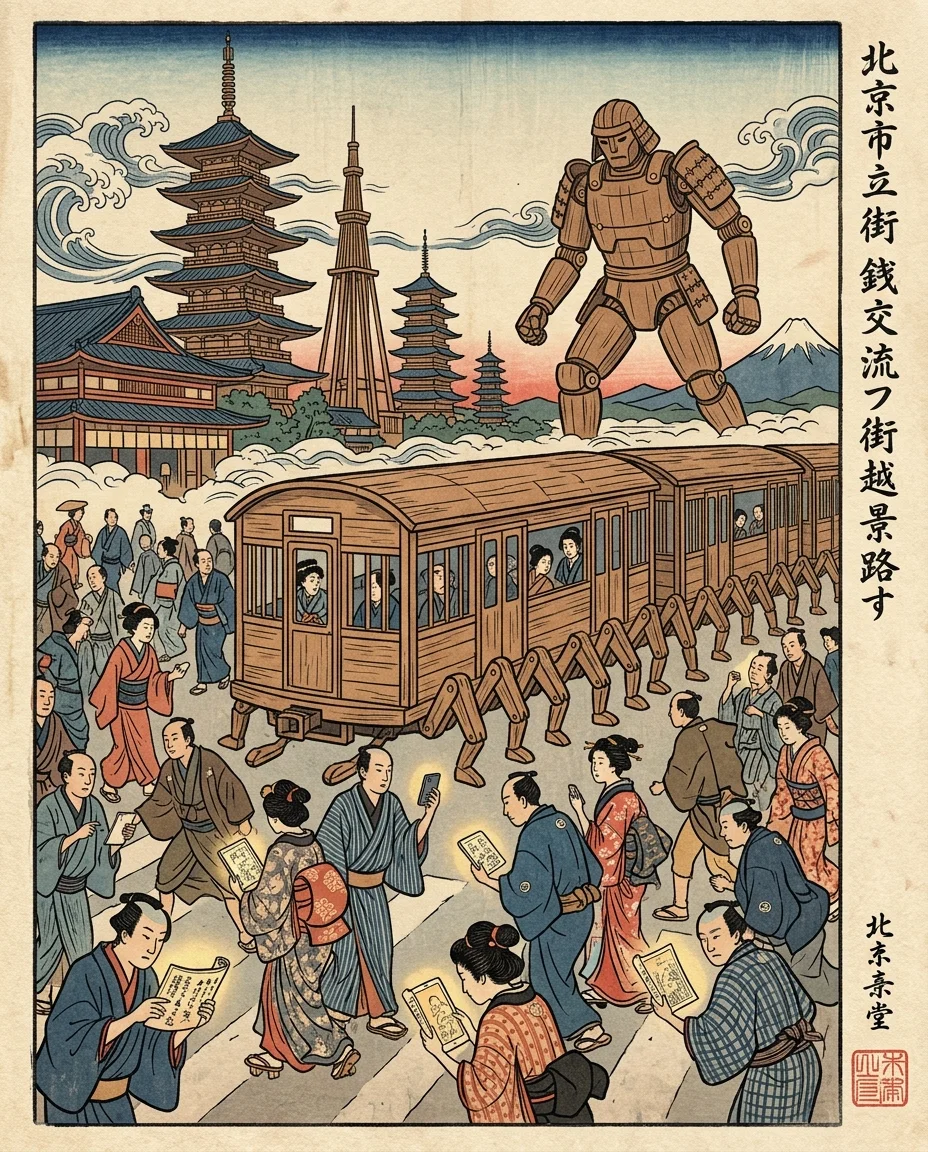
A Japanese Edo-period Ukiyo-e woodblock print, a surreal collaboration between Hokusai and Hiroshige reimagining modern technology through an ancient artistic lens. A busy metropolitan scramble crossing transformed through Edo-era logic: dozens of characters in period-accurate kimono surge across the intersection performing distinctly modern actions. Smartphones are glowing illustrated paper scrolls being read intently, illuminating faces with soft warm light. A giant articulated wooden centipede carriage shuffles through the crowd — a surreal Edo metro train with dozens of carved wooden legs, passengers visible through lattice windows. Behind the crossing, endless towering wooden pagodas reach into dramatic swirling clouds, replacing skyscrapers. A giant armored woodblock golem — an Edo robot — strides through the far background, its wooden joints articulated with brass pins. Flattened perspective with large bold hand-carved ink outlines. Heavily stylized Ukiyo-e wave patterns in the clouds, distant Mount Fuji on the horizon. Physical hand-pressed print texture with strong visible wood grain and rough paper fibers throughout. Pigment bleeding and slight color misalignment from simulated hand-pressed plates. Color palette strictly limited to traditional mineral pigments: dominant indigo blue, vermillion red, and muted yellow ochre. Lighting soft, flat, completely shadow-free, no digital gradients. Vertical poster composition. Vertical Japanese calligraphy describing the scene along one edge, a traditional red artist seal stamp in the lower corner. --ar 4:5
Todos los prompts de esta colección
Una estampa de xilografía Ukiyo-e del período Edo japonés, una colaboración surrealista entre Hokusai y Hiroshige que reimagina la tecnología moderna a través
A Japanese Edo-period Ukiyo-e woodblock print, a surreal collaboration between Hokusai and Hiroshige reimagining modern technology through an ancient artistic lens. A busy metropolitan scramble crossing transformed through Edo-era logic: dozens of characters in period-accurate kimono surge across the intersection performing distinctly modern actions. Smartphones are glowing illustrated paper scrolls being read intently, illuminating faces with soft warm light. A giant articulated wooden centipede carriage shuffles through the crowd — a surreal Edo metro train with dozens of carved wooden legs, passengers visible through lattice windows. Behind the crossing, endless towering wooden pagodas reach into dramatic swirling clouds, replacing skyscrapers. A giant armored woodblock golem — an Edo robot — strides through the far background, its wooden joints articulated with brass pins. Flattened perspective with large bold hand-carved ink outlines. Heavily stylized Ukiyo-e wave patterns in the clouds, distant Mount Fuji on the horizon. Physical hand-pressed print texture with strong visible wood grain and rough paper fibers throughout. Pigment bleeding and slight color misalignment from simulated hand-pressed plates. Color palette strictly limited to traditional mineral pigments: dominant indigo blue, vermillion red, and muted yellow ochre. Lighting soft, flat, completely shadow-free, no digital gradients. Vertical poster composition. Vertical Japanese calligraphy describing the scene along one edge, a traditional red artist seal stamp in the lower corner. --ar 4:5
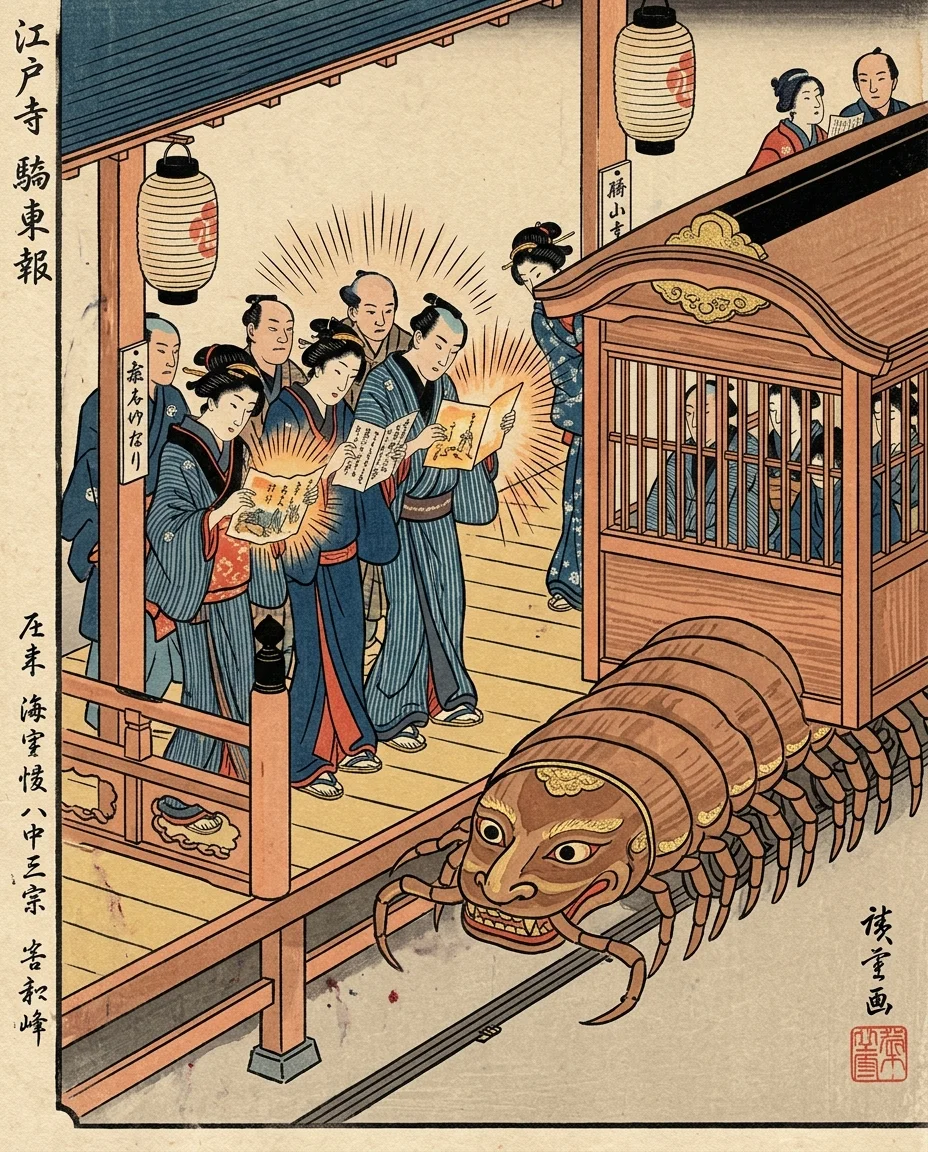
Detalle de una estampa de xilografía Ukiyo-e del período Edo japonés. Una vista cercana de una plataforma de madera elevada — una estación de metro reimaginada
A Japanese Edo-period Ukiyo-e woodblock print detail. A close view of a raised wooden platform — an Edo-reimagined metro station — where a cluster of figures in period-accurate kimono stand waiting, each reading a glowing illustrated paper scroll held at face height, the scrolls emitting visible warm light rendered as radiating ink lines. Their expressions are absorbed and focused. From the right edge of the frame, the front of a giant articulated wooden centipede carriage enters the station, its carved wooden head decorated with painted eyes and gilt detailing, dozens of carved legs visible beneath, lattice windows revealing seated passengers inside. The platform has carved wooden railings, paper lanterns hanging from posts, and small Edo-style signage with Japanese calligraphy. Flattened perspective with large bold hand-carved ink outlines. The image looks like a physical hand-pressed print with strong visible wood grain and rough paper fibers throughout. Pigment bleeding and slight color misalignment from simulated hand-pressed plates. Color palette strictly limited to traditional mineral pigments: dominant indigo blue, vermillion red, muted yellow ochre. Soft flat lighting, completely shadow-free, no digital gradients. Vertical Japanese calligraphy along one edge, traditional red artist seal stamp in the corner. --ar 4:5
Una estampa de xilografía Ukiyo-e del período Edo japonés centrada en un golem gigante de xilografía blindado — un mecha surrealista de la era Edo — que
A Japanese Edo-period Ukiyo-e woodblock print focusing on a giant armored woodblock golem — a surreal Edo-era mecha — striding through a cityscape of towering wooden pagodas. The golem's body is constructed from carved wooden panels with visible wood grain, jointed at the shoulders, elbows, and knees with large brass pins. Its chest plate is decorated with painted chrysanthemum crests in vermillion and gold. Its head is a stylized samurai kabuto helmet with sweeping horns. It carries an enormous paper fan in one hand and a lantern staff in the other, the lantern casting a warm glow rendered as radiating ink lines. Below its feet, tiny figures in period-accurate kimono look upward in awe, some pointing, others bowing. Towering wooden pagodas fill the background, their tiered roofs stretching into dramatic swirling Ukiyo-e clouds. Flattened perspective with large bold hand-carved ink outlines. Physical hand-pressed print texture with strong visible wood grain and rough paper fibers throughout. Pigment bleeding and slight color misalignment. Traditional mineral pigment palette: dominant indigo blue, vermillion red, muted yellow ochre, accents of gold. Soft flat lighting, completely shadow-free, no digital gradients. Vertical Japanese calligraphy along one edge, red artist seal stamp. --ar 4:5
Una estampa de xilografía Ukiyo-e del período Edo japonés representada como una vista cenital de pájaro que mira directamente hacia el cruce metropolitano....
A Japanese Edo-period Ukiyo-e woodblock print rendered as a bird's-eye overhead view looking directly down upon the metropolitan scramble crossing. The intersection is reimagined as a grand wooden plaza with radiating pathways. Dozens of figures in colorful period-accurate kimono cross in every direction, their movements forming an organic mandala-like pattern viewed from above — indigo, vermillion, ochre, and white kimono creating a mosaic of color. Two giant articulated wooden centipede carriages cross the intersection perpendicular to each other, their dozens of carved legs visible from above, lattice roof panels showing passengers within. At the corners of the crossing, small Edo market stalls with fabric awnings sell glowing illustrated paper scrolls. The surrounding buildings are the bases of towering wooden pagodas, their lowest tiers visible with sliding paper screens and hanging fabric noren. Flattened overhead perspective characteristic of Ukiyo-e bird's-eye compositions, bold hand-carved ink outlines. Physical hand-pressed print texture with strong visible wood grain and rough paper fibers. Pigment bleeding and slight color misalignment from hand-pressed plates. Color palette strictly limited to traditional mineral pigments: dominant indigo blue, vermillion red, muted yellow ochre. Soft flat lighting, shadow-free, no digital gradients. Vertical Japanese calligraphy along one edge, traditional red artist seal stamp. --ar 4:5
Una estampa de xilografía Ukiyo-e del período Edo japonés que representa el mismo cruce metropolitano por la noche. La escena se transforma con cálidas...
A Japanese Edo-period Ukiyo-e woodblock print depicting the same metropolitan scramble crossing at night. The scene is transformed by warm light: hundreds of paper lanterns hang from wooden posts and pagoda eaves, casting warm pools of amber rendered as radiating ink lines. Figures in period-accurate kimono cross the intersection, their glowing illustrated paper scrolls held up as they walk, each scroll emitting visible warm light that illuminates surrounding faces. The towering wooden pagodas rise into a deep indigo night sky filled with stylized Ukiyo-e stars and a large pale moon. A giant articulated wooden centipede carriage passes through, its lattice windows glowing amber from internal lanterns, dozens of carved legs moving. The giant armored woodblock golem is visible in the far distance, silhouetted against the moonlit sky, its lantern staff a bright point of light. Flattened perspective with large bold hand-carved ink outlines. Physical hand-pressed print texture with strong visible wood grain and rough paper fibers. Pigment bleeding and slight color misalignment. The night palette inverts the daytime scheme: dominant deep indigo blue for the sky and shadows, warm amber and ochre for lantern light, vermillion red accents on fabric and signage. Soft flat lighting, no digital gradients. Vertical Japanese calligraphy, traditional red artist seal stamp. --ar 4:5
Una estampa de xilografía Ukiyo-e del período Edo japonés en la gran tradición paisajística de las Treinta y seis vistas de Hokusai. La composición se aleja
A Japanese Edo-period Ukiyo-e woodblock print in the grand landscape tradition of Hokusai's Thirty-Six Views. The composition pulls far back to reveal Mount Fuji dominating the upper half of the frame, its snow-capped peak rendered in indigo and white with the precision of traditional woodblock printing. Dramatic swirling Ukiyo-e clouds — thick, curving, and decorative — frame the mountain's flanks. Below, the modern city reimagined as an Edo metropolis sprawls toward the mountain: a dense forest of towering wooden pagodas with tiered roofs, connected by bridges, with the scramble crossing visible as a tiny detailed square in the mid-ground. A giant articulated wooden centipede carriage snakes along a broad avenue toward the viewer. Tiny figures in kimono are visible on bridges and pathways. Cherry blossom trees in full bloom line a river running through the city, their pink petals drifting in stylized swirls. Flattened perspective with large bold hand-carved ink outlines. Physical hand-pressed print texture with strong visible wood grain and rough paper fibers. Pigment bleeding and slight color misalignment. Traditional mineral pigment palette: dominant indigo blue, vermillion red, muted yellow ochre, pale pink for cherry blossoms. Soft flat lighting, completely shadow-free, no digital gradients. Vertical Japanese calligraphy along one edge, red artist seal stamp. --ar 4:5
Una estampa de xilografía Ukiyo-e del período Edo japonés que representa el interior de un vagón gigante articulado de ciempiés de madera — el metro Edo....
A Japanese Edo-period Ukiyo-e woodblock print depicting the interior of a giant articulated wooden centipede carriage — the Edo metro. Passengers in period-accurate kimono sit on wooden benches along both sides, each reading a glowing illustrated paper scroll. Through the lattice windows on the left wall, the pagoda cityscape scrolls past — towering wooden pagodas, Ukiyo-e clouds, hanging shop banners. The carriage interior is detailed: polished dark wood panels, overhead fabric loops for standing passengers (reimagined as silk cord handles), a carved wooden announcement board with Japanese calligraphy replacing digital displays. In the foreground, a merchant in indigo kimono holds a large paper scroll showing an illustrated map of the Edo metro system — routes drawn as elegant curves with station names in calligraphy. A samurai stands near the door in full armor, gripping a silk cord handle, staring stoically ahead. The carriage gently rocks, indicated by the slightly diagonal angle of hanging silk cords. Flattened perspective with large bold hand-carved ink outlines. Physical hand-pressed print texture with strong visible wood grain and rough paper fibers. Pigment bleeding and slight color misalignment. Traditional mineral pigment palette: dominant indigo blue, vermillion red, warm wood brown, muted yellow ochre. Soft flat lighting, shadow-free, no digital gradients. Vertical Japanese calligraphy, red artist seal stamp. --ar 4:5
Más en Ilustración

Bulldogs Antropomórficos en una Barbacoa al Aire Libre — Animación Cel

Retrato de Reflejo en Espejo con Estilo de Arte Anime

Ilustración de Retrato Vibrante con Estilo Sticker Art

Retrato Digital Romántico con Flores Tropicales
Dibujo de Retrato Ultra Realista a Lápiz de Grafito

Retrato de Campo Dorado Pintado al Óleo Impasto