Diorama traditionnel de tube de pigment de paysage pressé
Cette collection visuelle contient 7 prompts autonomes fondés sur la même direction créative que l’image principale. Copiez chaque prompt séparément ou utilisez l’ensemble pour créer une série visuelle cohérente.
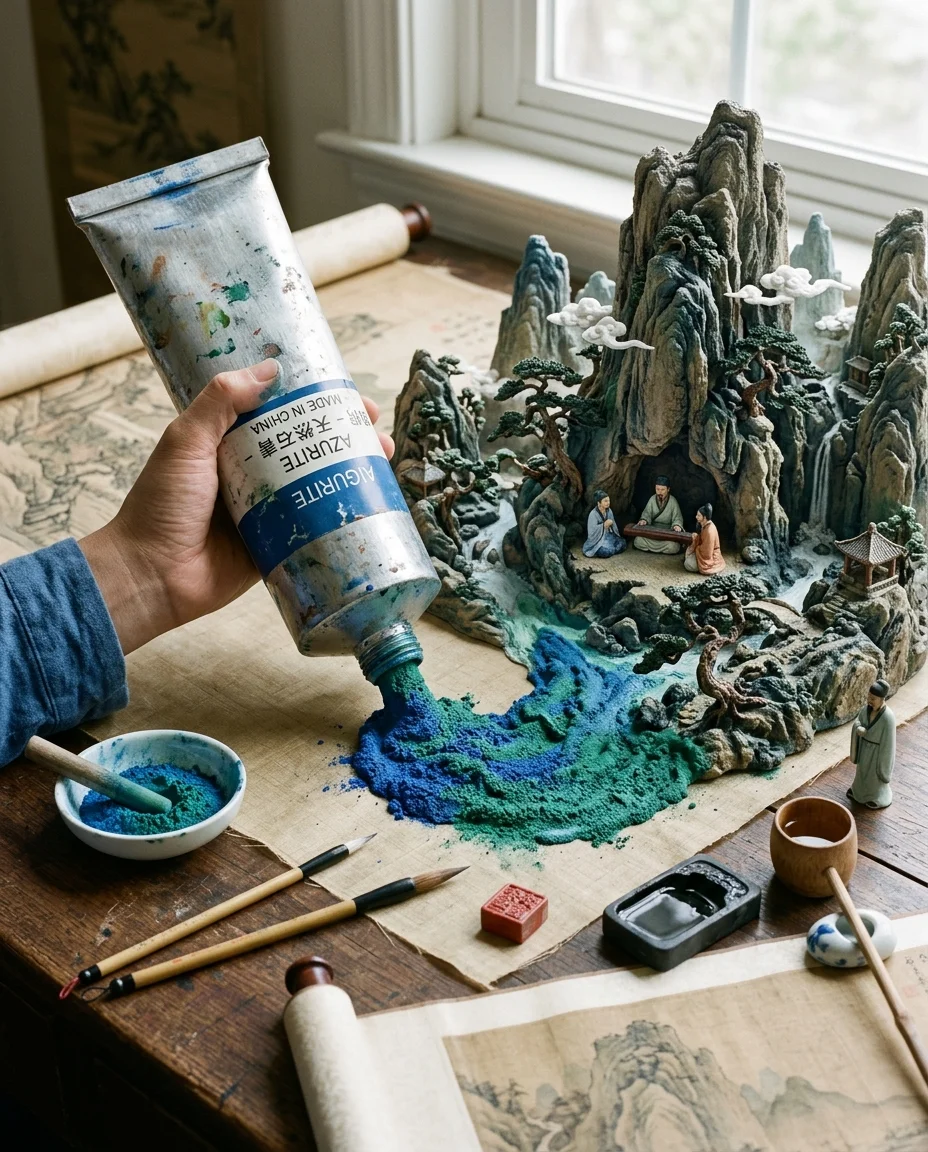
A creative artistic process photograph showing a giant realistic tube of mineral pigment paste in a rich Azurite Blue tone sitting on a sheet of antique silk with visible weave texture. The tube is being squeezed, and the medium emerging from it is a thick granular paste of vibrant Azurite Blue and Malachite Green mineral pigments. The paste flows outward and transforms into a majestic three-dimensional landscape: towering craggy mountains rise from the flowing paint, surrounded by white clouds formed from white pigment. Tiny figures of scholars playing a stringed instrument inside a cave and twisted pine trees emerge in delicate 3D relief from the mineral paste, all rendered with the meticulous detail of traditional fine brushwork. The texture throughout is thick matte mineral pigment with a slightly granular powdery look, distinctly different from oily Western paint — chalky, dense, authentically mineral-based. Surrounding the tube on the desk: fine-point wolf-hair calligraphy brushes, a ceramic bowl containing ground mineral powder, an ink stone with smooth grinding surface, a red seal stamp, and a tiny figurine of a scholar in flowing robes standing on the desk posed as if painting on a small scroll. An unrolled silk handscroll lies underneath. Soft diffused natural lighting without harsh reflections, letting the matte mineral colors speak. --ar 4:5
Tous les prompts de cette collection
Une photographie de processus artistique créatif montrant un tube géant réaliste de pâte de pigment minéral dans une riche teinte bleu azurite...
A creative artistic process photograph showing a giant realistic tube of mineral pigment paste in a rich Azurite Blue tone sitting on a sheet of antique silk with visible weave texture. The tube is being squeezed, and the medium emerging from it is a thick granular paste of vibrant Azurite Blue and Malachite Green mineral pigments. The paste flows outward and transforms into a majestic three-dimensional landscape: towering craggy mountains rise from the flowing paint, surrounded by white clouds formed from white pigment. Tiny figures of scholars playing a stringed instrument inside a cave and twisted pine trees emerge in delicate 3D relief from the mineral paste, all rendered with the meticulous detail of traditional fine brushwork. The texture throughout is thick matte mineral pigment with a slightly granular powdery look, distinctly different from oily Western paint — chalky, dense, authentically mineral-based. Surrounding the tube on the desk: fine-point wolf-hair calligraphy brushes, a ceramic bowl containing ground mineral powder, an ink stone with smooth grinding surface, a red seal stamp, and a tiny figurine of a scholar in flowing robes standing on the desk posed as if painting on a small scroll. An unrolled silk handscroll lies underneath. Soft diffused natural lighting without harsh reflections, letting the matte mineral colors speak. --ar 4:5
Une photographie en gros plan macro du bec d'un tube géant réaliste de pâte de pigment minéral bleu azurite. Le cadre...
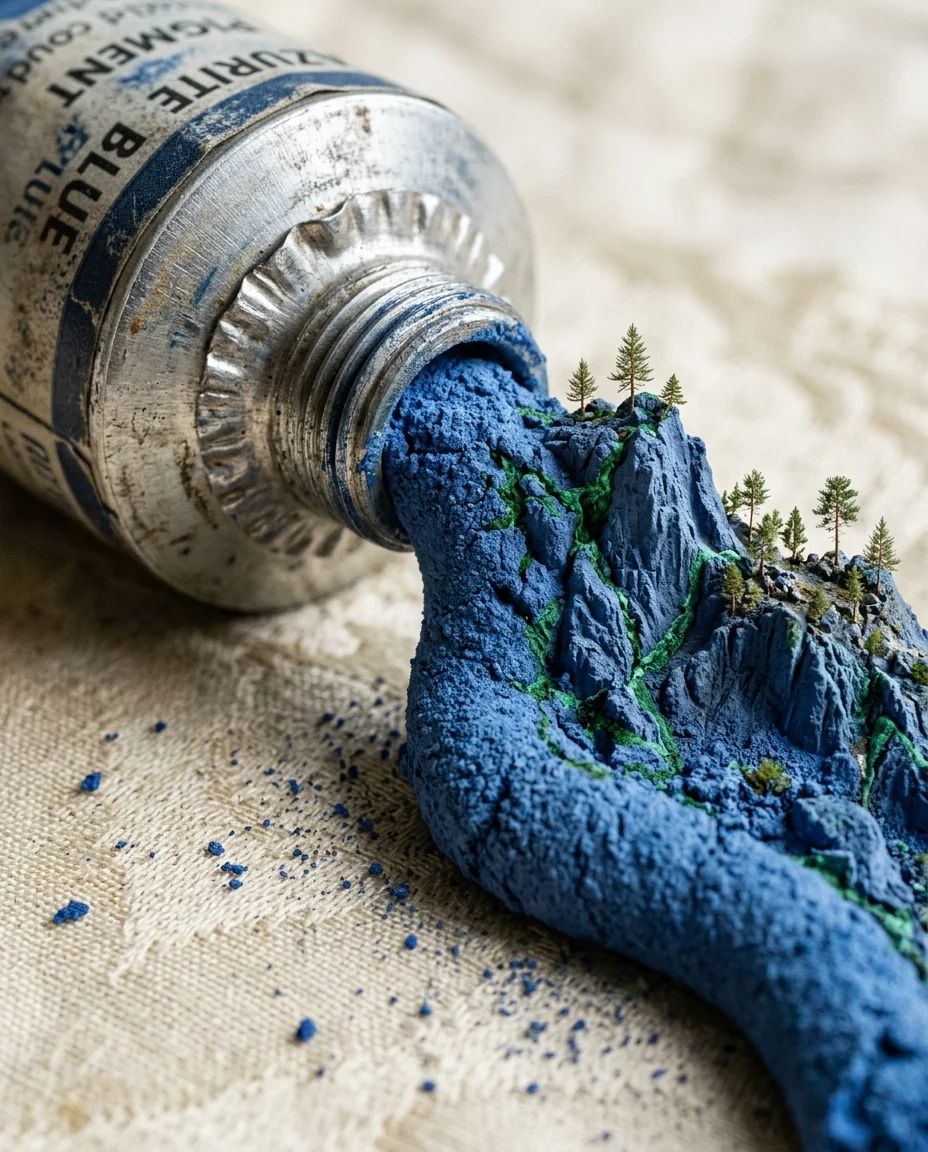
A macro close-up photograph of the nozzle of a giant realistic tube of Azurite Blue mineral pigment paste. The frame fills with the moment of transformation: thick granular mineral paste squeezes from the crimped metal nozzle in a dense, textured ribbon. Within centimeters of leaving the tube, the paste begins to rise and reshape — the leading edge of the paste is forming into the first craggy mountain peak, the blue mineral texture becoming rocky cliff faces with naturally occurring veins of Malachite Green. Tiny nascent pine trees, barely formed, sprout from the edges of the emerging paste. The granular, chalky texture of the mineral pigment is visible at extreme detail — individual mineral particles, the slightly rough matte surface, the dense powdery quality distinctly different from oil paint. The tube's metal body shows manufacturer's text and a crimped fold. Below, the antique silk sheet with visible weave catches a few loose mineral powder granules. Soft diffused natural lighting highlights the three-dimensional quality of the emerging landscape without creating harsh reflections on the matte pigment surface. The macro perspective makes the miniature transformation monumental. --ar 4:5
Une photographie aérienne regardant directement vers le bas sur l'ensemble de la disposition du bureau. La composition se révèle être un tableau artistique
An overhead photograph looking directly down at the entire desk arrangement. The composition is revealed as a deliberate artistic tableau: at the top of the frame, the giant tube of Azurite Blue mineral pigment paste lies at an angle, its nozzle pointing toward the center. From the nozzle, the thick mineral paste flows outward and transforms into the three-dimensional landscape — towering mountains, white pigment clouds, scholars in a cave, twisted pine trees — all visible from above, revealing the full extent of the miniature world. The landscape occupies the center of the desk on the antique silk sheet with visible weave texture. Arranged around the landscape at the margins: fine-point wolf-hair calligraphy brushes laid in a row to the left, a ceramic bowl of ground mineral powder at the upper right, the ink stone below it, the red seal stamp to the lower left, the tiny scholar figurine standing at the edge of the landscape as if surveying it. The unrolled silk handscroll extends from beneath the arrangement. Soft diffused overhead light creates no harsh shadows, the matte mineral textures reading clearly from above. The overhead perspective reveals the compositional harmony of the arrangement. --ar 4:5
Une photographie en gros plan de la petite figurine détaillée d'un érudit vêtu de robes traditionnelles fluides, debout sur le bureau...
A close-up photograph of the tiny detailed figurine of a scholar dressed in traditional flowing robes, standing on the desk surface at the edge of the mineral pigment landscape. The figurine is posed as if painting on a small silk scroll — one hand holds a miniature brush, the other steadies the tiny scroll. Behind and above the figurine, the three-dimensional landscape formed from Azurite Blue and Malachite Green mineral pigment paste towers upward like a real mountain range — from this low angle at the figurine's scale, the craggy mountains are monumental, the white pigment clouds dramatic, the twisted pine trees the size of real trees relative to the tiny figure. The figurine's flowing robes are rendered with extraordinary miniature detail — individual fabric folds, the drape of sleeves, tiny painted facial features showing concentration. On the desk surface around the figurine's feet: scattered mineral powder granules, the edge of the antique silk sheet, a single fine-point wolf-hair calligraphy brush lying nearby as if set down. Soft diffused natural lighting with gentle warmth, the matte mineral pigment landscape catching soft highlights on the mountain ridges. The scale illusion is complete. --ar 4:5
Une photographie de nature morte en gros plan des outils de calligraphie traditionnels disposés sur le drap de soie antique avec une texture de tissage
A close-up still life photograph of the traditional calligraphy tools arranged on the antique silk sheet with visible weave texture. Three fine-point wolf-hair calligraphy brushes of different sizes lie parallel, their bamboo handles smooth and aged, the wolf-hair tips stained with residual Azurite Blue and ink black — the hair points sharp and defined. The ink stone sits nearby, its smooth grinding surface showing traces of ground ink, a small pool of prepared ink glistening in the shallow well. A ceramic bowl containing finely ground mineral powder in vivid Malachite Green sits beside it, the powder's granular matte texture visible, a few grains scattered on the surrounding silk. The red seal stamp lies on its side, revealing its carved bottom face — an intricate Chinese character in mirror image ready for stamping, the vermillion ink paste still clinging to the carved surface. A corner of the unrolled silk handscroll is visible, its aged surface complementing the silk beneath. Soft diffused natural lighting, no harsh reflections, the matte and glossy textures of each tool reading distinctly. A still life celebrating the tools of traditional artistic creation. --ar 4:5
Une photographie en angle latéral prise au niveau du bureau, révélant la hauteur dramatique tridimensionnelle du paysage de pigments minéraux. De ce bas...
A side-angle photograph shot at desk level, revealing the dramatic three-dimensional height of the mineral pigment landscape. From this low perspective, the craggy mountains formed from thick Azurite Blue and Malachite Green mineral paste rise dramatically above the desk surface — the tallest peak reaching several inches high, its rocky faces textured with the chalky granular quality of authentic mineral pigment. White pigment clouds cling to the middle elevations of the mountains, their texture soft and matte. Tiny twisted pine trees rendered in delicate 3D relief cling to cliff edges and mountain slopes. Deep in a cave opening on one mountainside, the tiny figures of scholars are visible — one playing a stringed instrument, the scene illuminated by a warm glow from within. The mineral paste base spreads across the antique silk sheet, the transition from flat paste to three-dimensional landscape visible in the mid-ground. The giant Azurite Blue pigment tube is visible in the background, slightly out of focus. The desk-level camera angle makes the miniature landscape feel like a real mountain range. Soft diffused lighting from the left, catching highlights on the mountain ridges and casting gentle shadows in the valleys. --ar 4:5
Une photographie de processus artistique créatif montrant deux tubes géants réalistes de pâte de pigment minéral sur le drap de soie antique. Les...
A creative artistic process photograph showing two giant realistic tubes of mineral pigment paste on the antique silk sheet. The original Azurite Blue tube sits to the left, its paste flowing outward into the established three-dimensional mountain landscape. To the right, a second tube of rich Vermillion Red mineral pigment paste has been introduced, its paste squeezing out and flowing toward the blue mountains. Where the red paste meets the blue landscape, it transforms into autumn elements: crimson maple leaves growing from the mountain slopes, warm red-orange foliage on the twisted pine trees, a flowing stream of vermillion that winds between the blue-green mountain bases like a river of autumn color. The two mineral pigments interact but maintain their distinct granular textures — the blue chalky and cool, the red warm and dense. The scholars in the cave now appear amid autumn scenery. The traditional tools remain arranged on the desk: calligraphy brushes, ink stone, mineral powder bowl, red seal stamp, scholar figurine. The silk handscroll lies beneath. Soft diffused natural lighting, no harsh reflections. The color dialogue between the two pigments creates a seasonal narrative — the meeting of mineral colors producing a world. --ar 4:5