Cartaz Rasgado Revelando Duas Eras Contrastantes de uma Cidade Histórica
Esta coleção visual contém 7 prompts independentes baseados na mesma direção criativa da imagem principal. Copie qualquer prompt separadamente ou use o conjunto completo para criar uma série visual consistente.
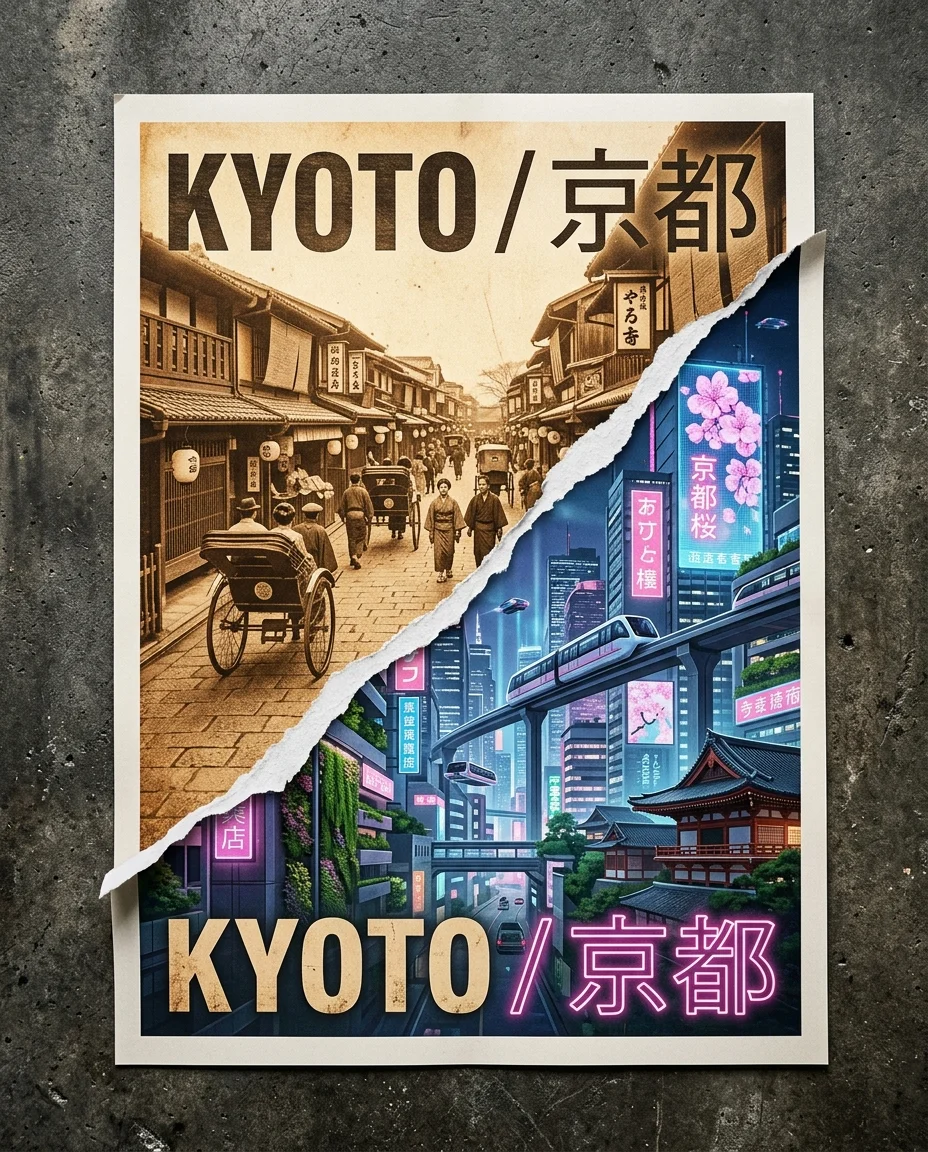
Top-down photograph of a printed poster lying flat on a dark textured concrete surface. The poster depicts a torn composition — the center torn diagonally from upper left to lower right, revealing two dramatically contrasting time periods of a historic Asian city. On the top-left torn layer, the city as it was in the 1920s — sepia-toned cobblestone streets with vintage hand-pulled rickshaws, rows of traditional wooden townhouses with latticed facades, sliding screens, and clay tile rooftops. The entire upper layer has a warm amber sepia color grade with soft film grain and faded edges evoking aged photography. On the bottom-right exposed layer beneath the tear, the same city reimagined in 2080 — hovering transit pods above magnetic rail lines, enormous holographic cherry blossom advertisements on glass skyscraper facades, vertical gardens cascading from cyber-inspired temple structures blending traditional curved rooflines with luminous neon elements. The torn paper edges between eras are crisp and textured with visible fiber strands, curling slightly, casting soft shadows onto the layer beneath. The city name spans both eras in bold display typography — transitioning from woodblock-style lettering on the vintage side to glowing neon characters on the futuristic side. A clean off-white border frames the entire poster. The dark concrete surface shows subtle grain texture beneath and around the poster edges. --ar 4:5
Todos os prompts desta coleção
Fotografia de cima para baixo de um pôster impresso deitado em uma superfície de concreto texturizado escuro. O pôster retrata uma composição rasgada...
Top-down photograph of a printed poster lying flat on a dark textured concrete surface. The poster depicts a torn composition — the center torn diagonally from upper left to lower right, revealing two dramatically contrasting time periods of a historic Asian city. On the top-left torn layer, the city as it was in the 1920s — sepia-toned cobblestone streets with vintage hand-pulled rickshaws, rows of traditional wooden townhouses with latticed facades, sliding screens, and clay tile rooftops. The entire upper layer has a warm amber sepia color grade with soft film grain and faded edges evoking aged photography. On the bottom-right exposed layer beneath the tear, the same city reimagined in 2080 — hovering transit pods above magnetic rail lines, enormous holographic cherry blossom advertisements on glass skyscraper facades, vertical gardens cascading from cyber-inspired temple structures blending traditional curved rooflines with luminous neon elements. The torn paper edges between eras are crisp and textured with visible fiber strands, curling slightly, casting soft shadows onto the layer beneath. The city name spans both eras in bold display typography — transitioning from woodblock-style lettering on the vintage side to glowing neon characters on the futuristic side. A clean off-white border frames the entire poster. The dark concrete surface shows subtle grain texture beneath and around the poster edges. --ar 4:5
Uma fotografia em close-up extremo da borda diagonal rasgada no centro do pôster deitado em um escuro...
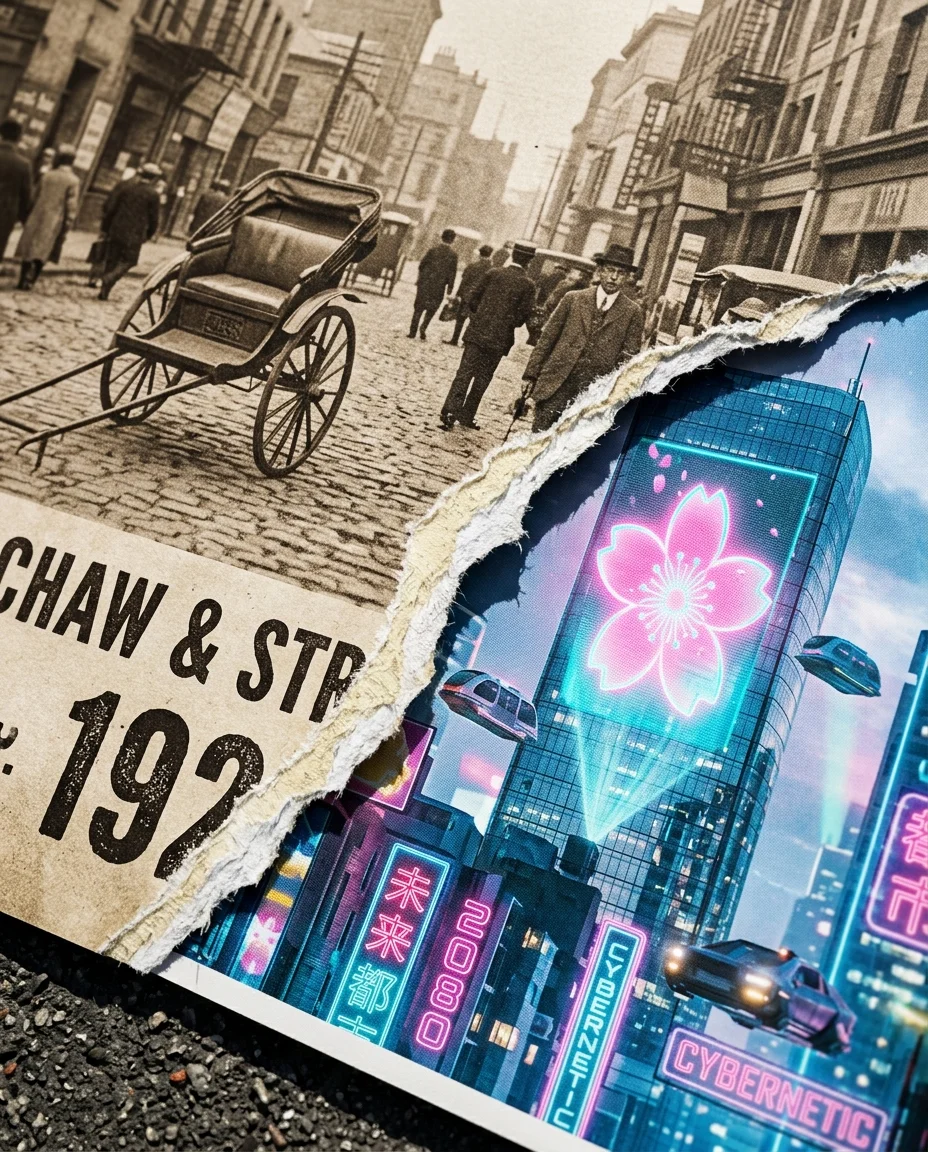
An extreme close-up photograph of the torn diagonal edge at the center of the poster lying flat on a dark concrete surface, where the 1920s vintage layer separates from the 2080 futuristic layer beneath. The torn paper edge is the focal point — visible fiber strands in cream and white curl away from the surface, some strands still connected, creating a tactile three-dimensional tear line. The paper thickness is perceptible, showing layered card stock with a white core. On the upper left of the tear, the sepia-toned 1920s city is visible in detail — a hand-pulled rickshaw with wooden wheels on a cobblestone street, the warm amber tone and soft film grain of the vintage layer. On the lower right below the tear, the 2080 city gleams — a holographic cherry blossom advertisement projects from a glass skyscraper facade in luminous pink and cyan, with a hovering transit pod visible in the distance. The torn edge casts a soft realistic shadow onto the futuristic layer below, approximately two millimeters wide. Where the typography transitions at the tear line, woodblock-carved letterforms on the vintage side abruptly meet glowing neon characters on the futuristic side. The dark concrete surface is barely visible at the poster's border. Macro lens detail reveals individual paper fibers and ink dot patterns. --ar 4:5
Fotografia de cima para baixo de um pôster impresso deitado em uma superfície de concreto escuro, cortado para focar no vintage dos anos 1920...
Top-down photograph of a printed poster lying flat on a dark concrete surface, cropped to focus on the 1920s vintage layer of the torn city poster. The upper-left portion fills the frame — sepia-toned cobblestone streets bustling with illustrated foot traffic, vintage hand-pulled rickshaws with detailed wooden wheels and woven canopy covers. Rows of traditional wooden townhouses line the street, their latticed facades showing individual wooden slat detail, sliding paper screens in various states of open and closed, and clay tile rooftops with visible weathering and moss growth. Hanging shop banners with woodblock-printed text add vertical rhythm to the street scene. The entire surface has a warm amber sepia color grade with soft film grain scattered across the image, faded edges darkening toward the corners, and subtle foxing marks that suggest aged paper. Small period-accurate details enhance authenticity — a traditional street lamp, stacked barrels outside a shop, a stone water basin at a corner. The typography section visible in this crop shows the city name in hand-carved woodblock style with visible ink texture and slight printing irregularities. The poster sits on the dark concrete surface with its cream-white border partially visible. Soft diffused studio light illuminates the poster evenly. --ar 4:5
Fotografia de cima para baixo de um pôster impresso deitado em uma superfície de concreto escuro, cortado para focar no futurista de 2080...
Top-down photograph of a printed poster lying flat on a dark concrete surface, cropped to focus on the 2080 futuristic layer of the torn city poster. The lower-right portion fills the frame — a photorealistic futuristic metropolis with hovering transit pods gliding silently above elevated magnetic rail lines rendered in sleek silver. Enormous holographic cherry blossom advertisements project from glass skyscraper facades in luminous pink, magenta, and soft cyan, the blossoms appearing to float in mid-air with translucent petal detail. Sleek vertical gardens cascade lush greenery from towering cyber-inspired temple structures that blend traditional curved Asian rooflines with luminous neon structural elements in electric blue and warm gold. The street level shows pedestrians in futuristic attire walking on transparent elevated walkways. The rendering is photorealistic with real-world architectural detail — glass reflections catching holographic light, atmospheric haze softening distant towers, volumetric light from neon signs creating colored fog at street level. The typography section shows the city name in sleek glowing sci-fi neon characters with sharp edges and subtle outer glow. The torn edge of the vintage layer above casts a thin shadow onto this futuristic surface. The poster sits on dark concrete with its border visible. --ar 4:5
Uma fotografia em close-up extremo da tipografia do título do pôster onde ele transita na borda diagonal rasgada. O nome da cidade...
An extreme close-up photograph of the poster's title typography where it transitions at the torn diagonal edge. The city name spans across both eras — on the left side of the tear, the characters are rendered in hand-carved woodblock style with visible ink texture, slight printing irregularities, chipped edges, and warm sepia-brown ink on aged cream paper. The letterforms are bold with traditional serif weight and the organic imperfection of physical woodblock printing. At the exact tear line, the same city name continues on the right side in sleek glowing sci-fi neon characters — sharp vector edges, electric cyan core glow with a soft blue outer aura, the letterforms floating slightly above the poster surface with a subtle drop shadow. The transition is abrupt and dramatic — handmade woodblock meets digital precision at the torn paper edge. Individual paper fibers from the tear cross over the typography transition. The poster lies flat on the dark concrete surface visible at the edges. The contrast between warm aged ink and cool electric neon light creates a powerful visual metaphor for the passage of time. Macro lens sharpness reveals every ink fiber and neon pixel. Soft studio lighting from above. --ar 4:5
Uma fotografia em ângulo baixo do pôster rasgado da cidade deitado em uma superfície de concreto escuro, tirada de uma perspectiva rasa que...
A low-angle photograph of the torn city poster lying on a dark concrete surface, shot from a shallow perspective that emphasizes the poster's physical presence as a printed object. The camera is positioned just above the concrete surface looking across the poster at a raking angle, revealing the slight curl at the poster corners, the paper thickness at the edges, and the three-dimensional quality of the torn diagonal where paper fibers lift away from the surface and cast long shadows in the directional light. The poster's off-white border is prominent from this angle, giving it the quality of a gallery-ready print. The full composition is visible — the 1920s sepia cityscape on the upper-left torn layer, the 2080 neon metropolis on the lower-right layer, and the bold transitioning typography across the center. The dark concrete surface stretches into the foreground with visible texture — small aggregate stones, hairline cracks, and subtle color variation. Directional studio light from the upper right creates dramatic shadows from the poster's curled corners and torn edges, adding depth and physical dimensionality to the flat print. The lighting also creates a subtle gradient across the poster surface, brighter on the right, deeper on the left. --ar 4:5
Fotografia de cima para baixo do pôster rasgado da cidade em concreto escuro, com a câmera enquadrando uma comparação específica através do rasgado...
Top-down photograph of the torn city poster on dark concrete, with the camera framing a specific comparison across the torn edge — a traditional wooden rickshaw from the 1920s layer directly adjacent to a hovering transit pod from the 2080 layer. On the sepia-toned left side, the hand-pulled rickshaw shows exquisite period detail — wooden spoke wheels, a woven bamboo canopy, rope-lashed joints, and a pulling bar resting on cobblestones. The warm amber film grain and faded quality anchor it in the past. Across the torn edge on the futuristic right side, a sleek hovering transit pod floats above a magnetic rail line — its aerodynamic shell reflects holographic advertisements from nearby buildings, with small blue thruster lights glowing beneath. The torn paper fibers bridge the gap between both vehicles, fibers from the vintage layer curling over the futuristic surface. The juxtaposition reads as a direct evolution — same function, separated by 160 years of design innovation. The poster border is visible, and the dark concrete surface provides grounding context. Soft even studio lighting with subtle directional shadow from the torn edge. --ar 4:5
Mais em Cartazes e Flyers

Mago Explodindo Carta de Baralho — Pôster de Filme

Pôster de Anúncio de Moda com Pose Editorial
Transformação de Cartaz de Filme em Origami de Papel
Ilustração de Trabalho em Casa com Cores Vibrantes e Pop
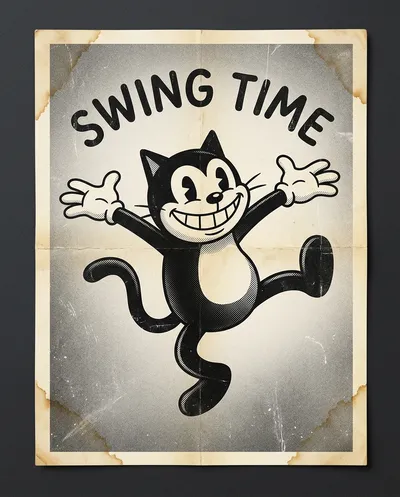
Pôster de Gato Dançarino Estilo Rubber Hose Anos 30
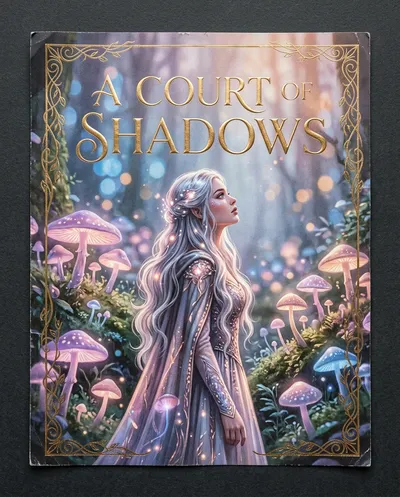
Capa de Livro Fantasy Romantasy com Cogumelos Brilhantes