Teoría científica como escultura isométrica 3D
Esta colección visual contiene 7 prompts independientes basados en la misma dirección creativa que la imagen principal. Copia cualquier prompt por separado o utiliza el conjunto completo para crear una serie visual coherente.
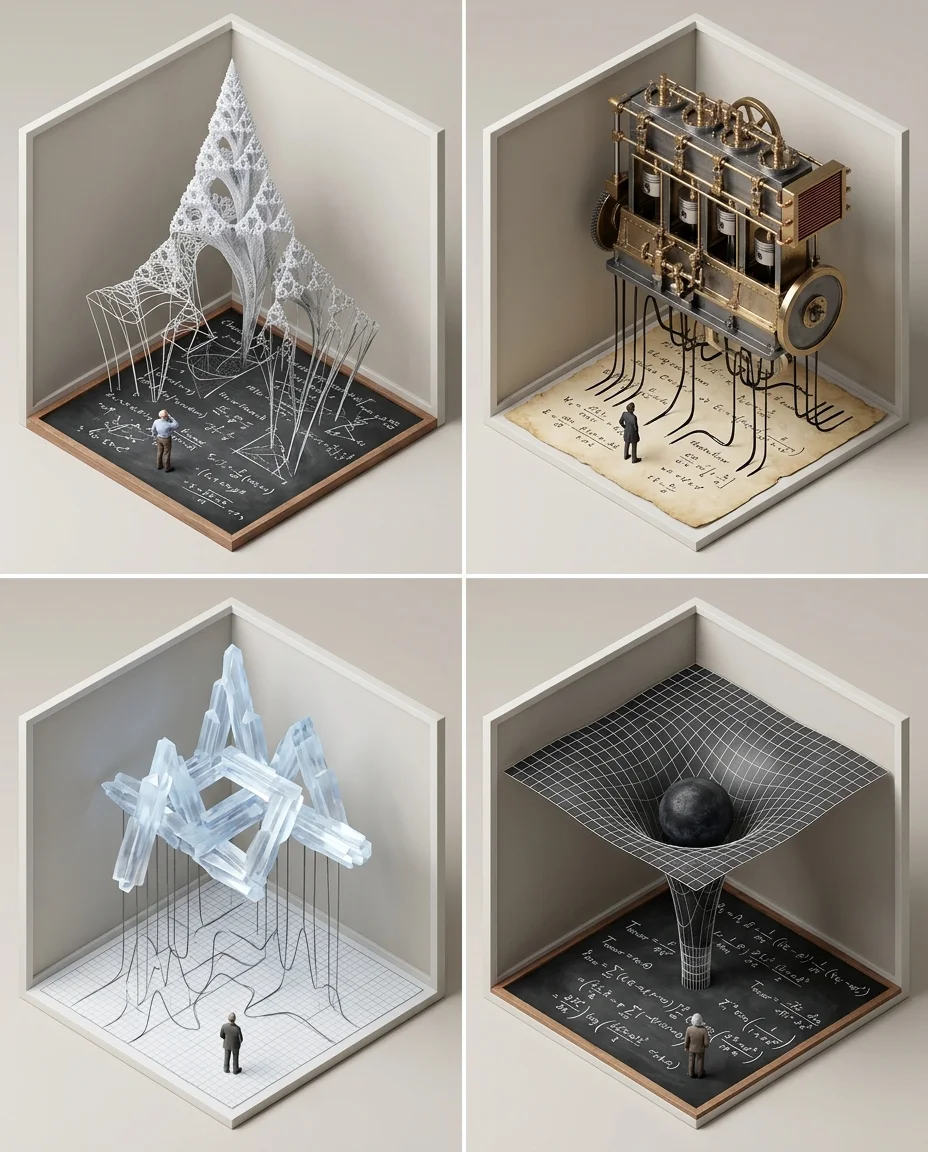
A two-by-two grid presenting four famous doctoral-level science topics, each visualized as a dramatic dimensional transition from flat notation to a towering three-dimensional impossible structure. Top-left panel: Chaos Theory — a slate blackboard dense with chalk equations, the white chalk lines physically lifting off the surface, beginning as wireframes that gain opacity and texture as they rise, solidifying at the top into a photorealistic fractal spire structure with recursive branching geometry in crystalline white. A tiny figure of Edward Lorenz stands on the blackboard looking upward in awe. Top-right panel: Thermodynamics — aged parchment covered in ink equations, the ink lines rising and thickening into a massive industrial engine block structure with pistons, valves, and heat exchangers in polished brass and steel. A tiny figure of Sadi Carnot stands on the parchment gazing up. Bottom-left panel: Quantum Mechanics — graph paper covered in pencil wave functions, the graphite lines rising into an impossible interlocking probability wave structure in translucent blue-white crystal. A tiny Niels Bohr figure stands below. Bottom-right panel: General Relativity — a blackboard with tensor equations in chalk, the lines rising into a massive curved spacetime grid structure that warps and bends around a central dense sphere. A tiny Albert Einstein figure stands at the base. High-angle isometric perspective, designer toy aesthetic, clean neutral backgrounds per panel, soft studio lighting. --ar 4:5
Todos los prompts de esta colección
Una cuadrícula de dos por dos que presenta cuatro temas científicos famosos a nivel de doctorado, cada uno visualizado como una transición dimensional
A two-by-two grid presenting four famous doctoral-level science topics, each visualized as a dramatic dimensional transition from flat notation to a towering three-dimensional impossible structure. Top-left panel: Chaos Theory — a slate blackboard dense with chalk equations, the white chalk lines physically lifting off the surface, beginning as wireframes that gain opacity and texture as they rise, solidifying at the top into a photorealistic fractal spire structure with recursive branching geometry in crystalline white. A tiny figure of Edward Lorenz stands on the blackboard looking upward in awe. Top-right panel: Thermodynamics — aged parchment covered in ink equations, the ink lines rising and thickening into a massive industrial engine block structure with pistons, valves, and heat exchangers in polished brass and steel. A tiny figure of Sadi Carnot stands on the parchment gazing up. Bottom-left panel: Quantum Mechanics — graph paper covered in pencil wave functions, the graphite lines rising into an impossible interlocking probability wave structure in translucent blue-white crystal. A tiny Niels Bohr figure stands below. Bottom-right panel: General Relativity — a blackboard with tensor equations in chalk, the lines rising into a massive curved spacetime grid structure that warps and bends around a central dense sphere. A tiny Albert Einstein figure stands at the base. High-angle isometric perspective, designer toy aesthetic, clean neutral backgrounds per panel, soft studio lighting. --ar 4:5
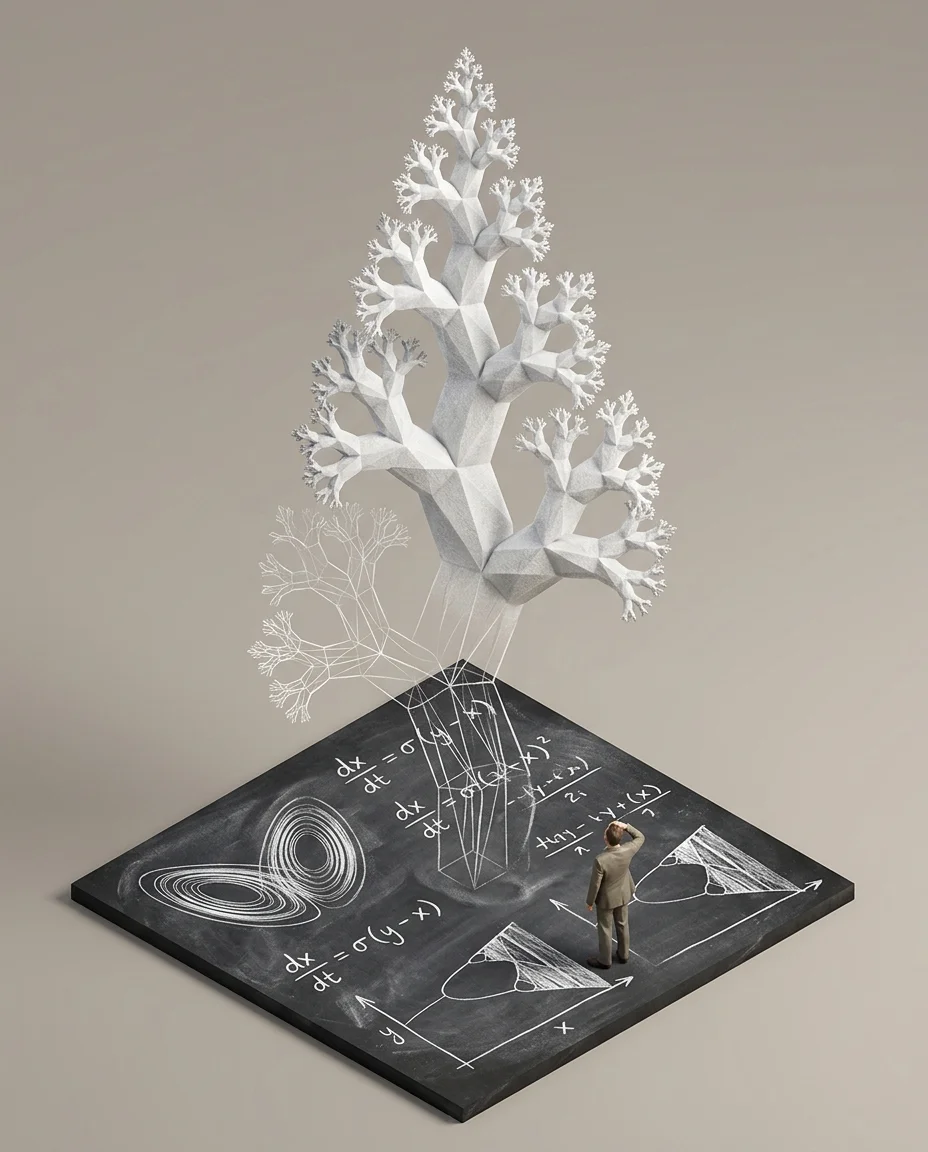
Un solo panel de una serie de visualización de teorías científicas, renderizado en perspectiva isométrica de ángulo alto con una estética de juguete de
A single panel from a scientific theory visualization series, rendered in high-angle isometric perspective with a designer toy aesthetic. A slate blackboard surface fills the base, dense with handwritten chalk equations — Lorenz attractors, differential equations, and bifurcation diagrams in white chalk with slight dust halos. The chalk lines physically lift off the blackboard surface — at the base they are thin white wireframes barely risen from the slate. As they ascend, the wireframes gradually gain opacity, then texture, then mass. At the summit, a towering photorealistic fractal spire has fully solidified — a recursive branching structure in crystalline white material with faceted geometric planes, each branch splitting into smaller branches in self-similar patterns. The transition from sketch to solid occupies the full vertical height of the image. Standing on the flat chalk-covered blackboard section, a tiny scale-model figure of a scientist in a mid-century suit looks upward in awe at the massive fractal structure towering above, one hand raised to shield their eyes. The stark visual contrast between the sketchy hand-drawn chalk at the base and the solid textured mass at the summit is dramatic. Clean neutral warm-grey background. Soft studio lighting highlights the crystalline fractal surfaces. --ar 4:5
Un solo panel de una serie de visualización de teorías científicas, renderizado en perspectiva isométrica de ángulo alto con una estética de juguete de
A single panel from a scientific theory visualization series, rendered in high-angle isometric perspective with a designer toy aesthetic. Aged parchment fills the base, covered in precise ink equations and engineering diagrams of heat engines, pressure-volume curves, and entropy notation in brown and black ink with slight bleed into the parchment fibers. The ink lines physically lift off the parchment surface — at the base they are thin dark wireframes barely risen. As they ascend, they gradually gain opacity, then metallic texture, then industrial mass. At the summit, a towering photorealistic industrial engine block has fully solidified — polished brass pistons, steel connecting rods, copper heat exchangers with patina, iron flywheels with visible casting marks, and steam vents trailing wisps of vapor. The mechanical complexity is extraordinary, every component engineered with Victorian-era precision. Standing on the flat parchment section, a tiny scale-model figure in 19th-century attire looks upward in awe at the massive brass engine block, one hand adjusting tiny spectacles. Clean neutral warm-grey background. Soft studio lighting creates warm highlights on the brass and steel surfaces, emphasizing the material differentiation between cold iron and warm copper. --ar 4:5
Un solo panel de una serie de visualización de teorías científicas, renderizado en perspectiva isométrica de ángulo alto con una estética de juguete de
A single panel from a scientific theory visualization series, rendered in high-angle isometric perspective with a designer toy aesthetic. Graph paper fills the base, covered in precise pencil drawings — wave functions, Schrödinger equations, probability density plots, and orbital diagrams in graphite with faint grid lines visible beneath. The pencil lines physically lift off the graph paper — at the base they are thin grey wireframes barely risen from the paper surface. As they ascend, the wireframes gain translucency, then crystalline texture, then solid form. At the summit, a towering impossible probability wave structure has fully solidified — interlocking translucent blue-white crystalline forms that represent standing waves, with inner surfaces showing refracted light patterns and interference fringes. Some sections are nearly transparent, others are densely opaque, visualizing probability density as material transparency. Tiny glowing particle points orbit the crystal structure along defined orbital paths. Standing on the flat graph paper section, a tiny scale-model figure in early 20th-century attire looks upward with hands clasped behind their back, dwarfed by the quantum structure above. Clean neutral cool-grey background. Soft studio lighting catches the translucent crystal faces, creating caustic light patterns on the graph paper below. --ar 4:5
Un solo panel de una serie de visualización de teorías científicas, renderizado en perspectiva isométrica de ángulo alto con una estética de juguete de
A single panel from a scientific theory visualization series, rendered in high-angle isometric perspective with a designer toy aesthetic. A dark slate blackboard fills the base, covered in chalk tensor equations — Einstein field equations, Christoffel symbols, metric tensors, and Riemann curvature notation in white and yellow chalk with dust smudges. The chalk lines physically lift off the blackboard — at the base they are thin pale wireframes barely risen. As they ascend, the wireframes gain structure, then mass, then gravitational weight. At the summit, a massive curved spacetime grid structure has solidified — a three-dimensional mesh of polished chrome rods forming a smooth grid that dramatically warps and curves inward around a central dense sphere of dark matter. The sphere pulls the grid lines into a deep gravitational well, the rods bending smoothly under the curvature. The grid extends outward and flattens toward the edges, showing the transition from curved to flat spacetime. Tiny luminous points of light travel along the grid lines like test particles following geodesics. Standing on the flat blackboard section, a tiny scale-model figure with wild grey hair and a rumpled sweater looks upward in wonder at the spacetime structure above. Clean neutral dark-grey background. Soft studio lighting creates chrome reflections on the grid rods. --ar 4:5
Fotografía macro de primer plano extremo de la zona de transición dimensional en uno de los paneles de visualización de teorías científicas. El encuadre...
An extreme close-up macro photograph of the dimensional transition zone in one of the scientific theory visualization panels. The frame captures the exact point where flat two-dimensional chalk equations on a blackboard surface begin lifting into three-dimensional wireframe structures. At the base, chalk lines are flat on the slate — visible chalk dust, the texture of the blackboard surface, individual chalk stroke marks. Just above the surface, the same chalk lines detach and rise as thin white wireframes, still ghostly and translucent but now occupying three-dimensional space. Higher in the frame, the wireframes have gained partial opacity — some surfaces are beginning to fill in with solid material while the underlying wireframe grid is still visible through translucent patches. The transition is gradual and organic, like watching matter crystallize from mathematical notation. Tiny scale details are visible — a chalk-dust particle caught mid-air between the flat equations and the risen wireframe, a wireframe joint where two lines intersect and begin to form a solid node. The blackboard slate shows its natural texture — grey-green with faint scratches from years of use. Soft studio lighting from above highlights the three-dimensional depth of the rising structures against the flat base. Isometric macro perspective. --ar 4:5
Una fotografía amplia que muestra las cuatro esculturas de visualización de teorías científicas expuestas en un largo estante minimalista blanco de museo
A wide photograph showing all four scientific theory visualization sculptures displayed on a long minimalist white museum shelf against a clean neutral gallery wall. Each sculpture sits on its own notation base — the blackboard with fractal spire, the parchment with engine block, the graph paper with quantum crystal, and the blackboard with spacetime grid — all rendered as physical three-dimensional objects at collectible display scale, approximately twenty centimeters tall each. The shelf is lit by subtle museum track lighting from above, each spotlight creating a focused pool of illumination on its respective sculpture with soft shadows falling on the wall behind. The four tiny scientist figures are visible standing on their respective bases, barely perceptible at this scale. Between the sculptures, small white museum labels are propped on the shelf. The gallery wall behind is clean white with a subtle texture. The shelf itself has clean lines and a thin profile, floating on the wall with no visible brackets. The composition reads as a premium collectible display or museum exhibition of scientific visualization art. Deep depth of field keeps all four sculptures sharp. Soft even gallery lighting with the track spots adding gentle drama. --ar 4:5
Más en Abstracto y Artístico

Lienzo Impasto Acrílico — Retrato Editorial Macro
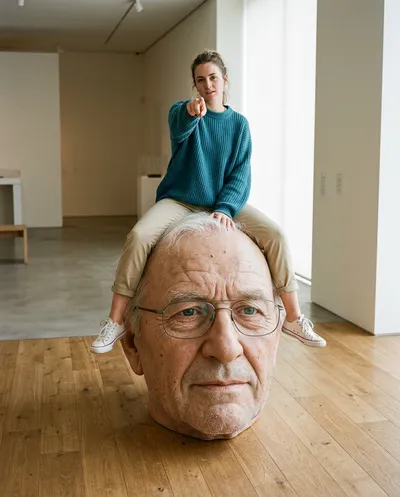
Retrato Conceptual Surrealista con Distorsión de Escala

Composición Surrealista Miniatura de Baile en Smartphone

Busto de Retrato de Escultura de Madera Tallada Polícroma
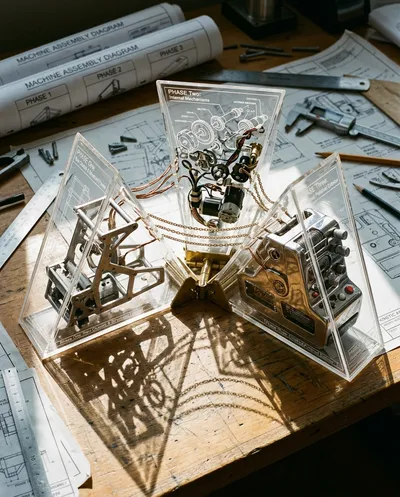
Diorama Cinético de Descomposición de Máquina con Planos
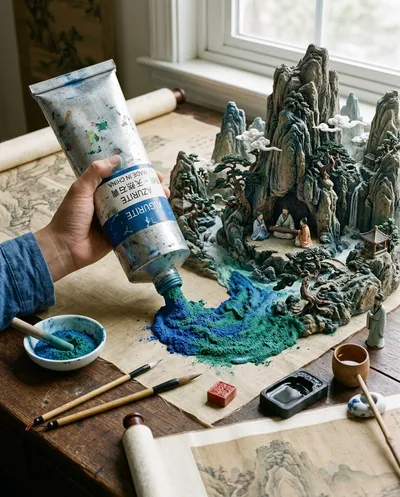
Diorama Tradicional de Tubo de Pigmento de Paisaje Exprimido