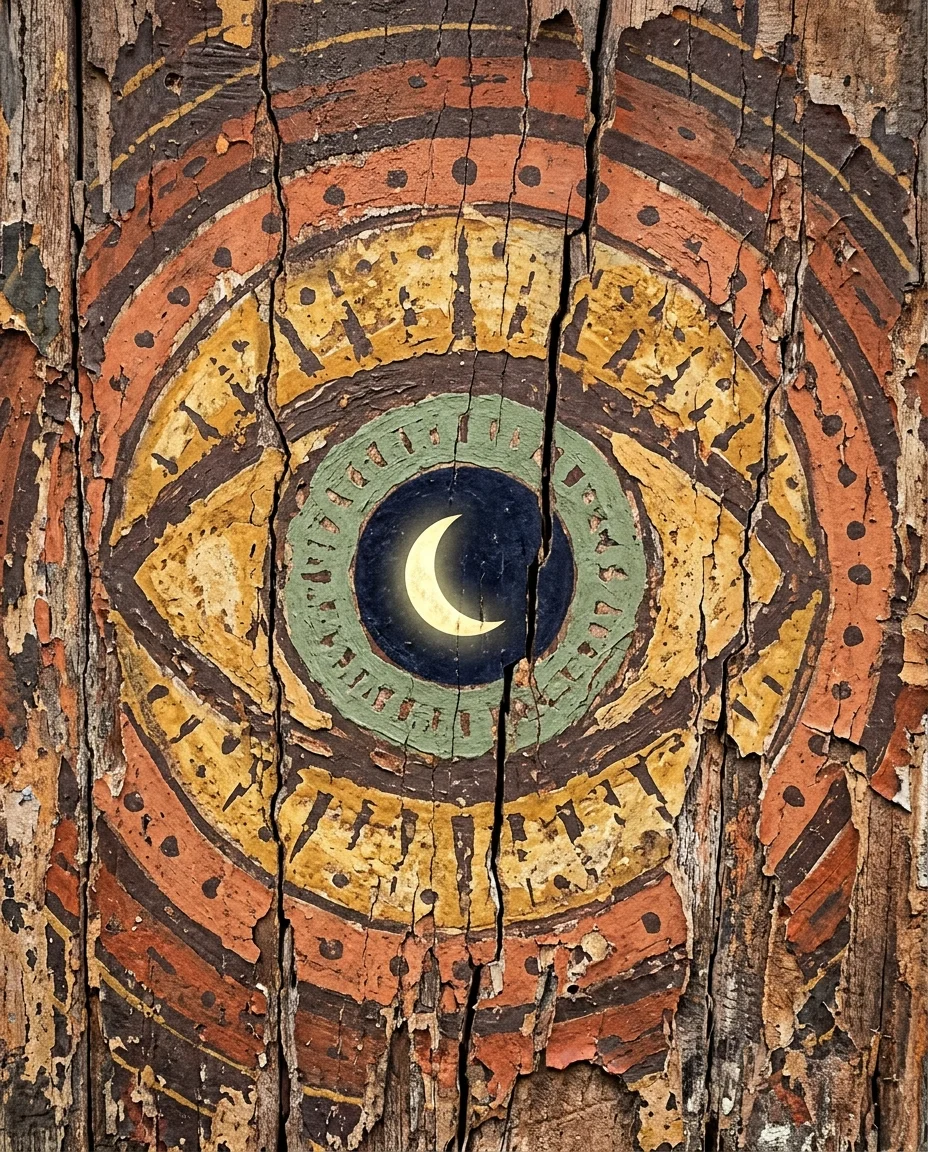
Ojo místico abstracto con luna creciente sobre superficie envejecida
Esta colección visual contiene 7 prompts independientes basados en la misma dirección creativa que la imagen principal. Copia cualquier prompt por separado o utiliza el conjunto completo para crear una serie visual coherente.
A close-up abstract and heavily textured image featuring a stylized eye with a luminous crescent moon nestled within its pupil, set against concentric radiating circles of ochre yellow and sage green that emanate outward from the eye like ripples or ancient astronomical diagrams. The eye is rendered in a graphic symbolic style rather than anatomical realism, with bold simplified shapes defining the iris, surrounding color rings, and the crescent moon element glowing faintly within the dark pupil center. The background is a distressed and deeply weathered surface showing vertical cracks that split through layers of accumulated paint, with areas of peeling and flaking paint in shades of burnt sienna, terracotta orange, and aged ochre yellow. The entire surface conveys the appearance of an aged and rustic artifact — as if discovered on the wall of an ancient temple or painted onto a centuries-old wooden panel that has endured decades of exposure. The textural deterioration is integral — cracks running through the eye design itself and chips of missing paint revealing darker underlayers. The overall mood is mysterious and somewhat unsettling, blending occult symbolism with archaeological discovery aesthetics. The color palette is limited to warm earth tones of brown, orange, yellow, and muted green, with the crescent moon providing the only cool-toned accent. --ar 4:5
Todos los prompts de esta colección
Una imagen abstracta y muy texturizada en primer plano que presenta un ojo estilizado con una luna creciente luminosa anidada dentro de su pupila,...
A close-up abstract and heavily textured image featuring a stylized eye with a luminous crescent moon nestled within its pupil, set against concentric radiating circles of ochre yellow and sage green that emanate outward from the eye like ripples or ancient astronomical diagrams. The eye is rendered in a graphic symbolic style rather than anatomical realism, with bold simplified shapes defining the iris, surrounding color rings, and the crescent moon element glowing faintly within the dark pupil center. The background is a distressed and deeply weathered surface showing vertical cracks that split through layers of accumulated paint, with areas of peeling and flaking paint in shades of burnt sienna, terracotta orange, and aged ochre yellow. The entire surface conveys the appearance of an aged and rustic artifact — as if discovered on the wall of an ancient temple or painted onto a centuries-old wooden panel that has endured decades of exposure. The textural deterioration is integral — cracks running through the eye design itself and chips of missing paint revealing darker underlayers. The overall mood is mysterious and somewhat unsettling, blending occult symbolism with archaeological discovery aesthetics. The color palette is limited to warm earth tones of brown, orange, yellow, and muted green, with the crescent moon providing the only cool-toned accent. --ar 4:5
Una fotografía macro extrema centrada en la pupila oscura del ojo místico estilizado, donde anida una luna creciente luminosa...
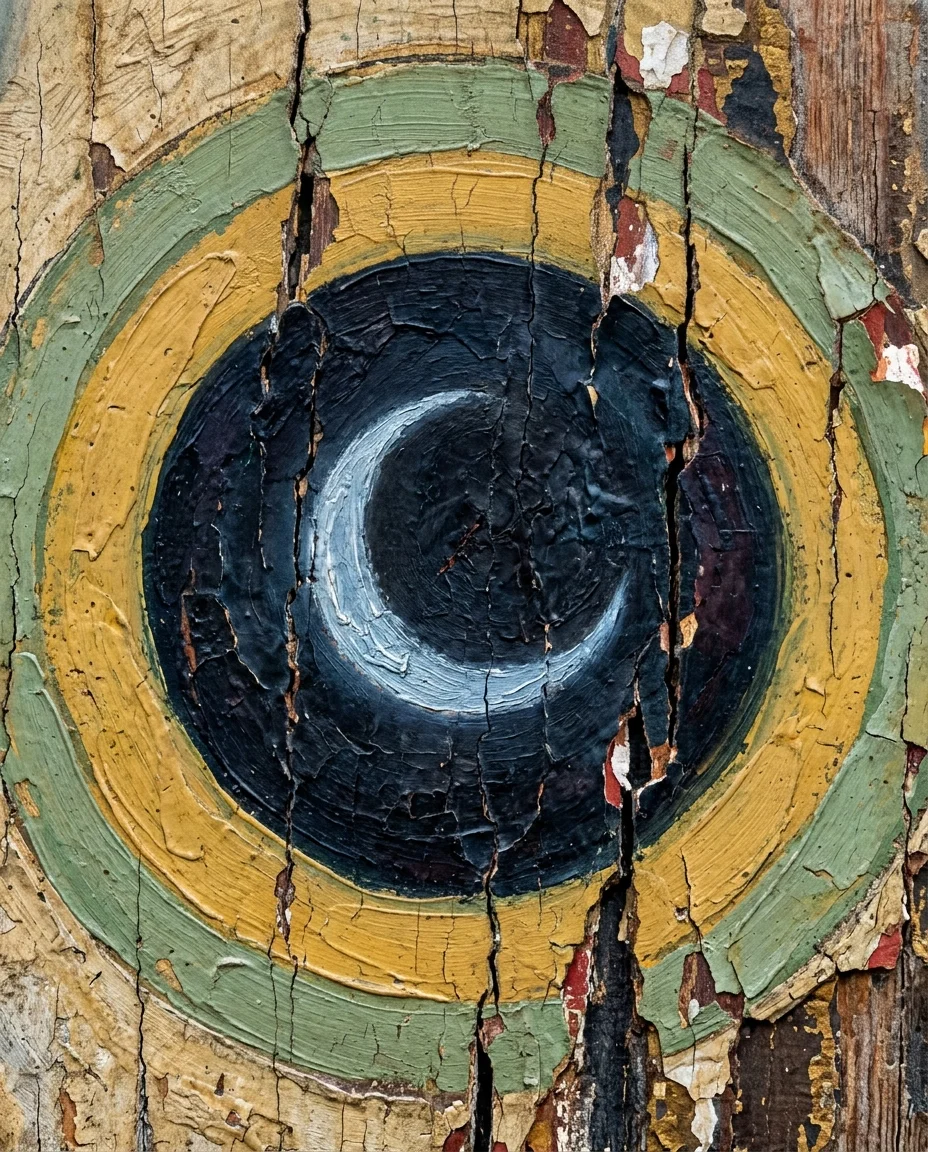
An extreme macro photograph centered on the dark pupil of the stylized mystical eye, where a luminous crescent moon nestles within the void. The pupil is rendered as a deep void of layered dark paint — near-black with hints of deep indigo where the paint has thinned with age. The crescent moon within is the composition's focal point — a thin curved form in pale silvery-blue that appears to glow faintly from within, the only cool-toned element in the warm earth-tone palette. The moon's surface shows painted texture — visible brushstrokes in the pale pigment with slight impasto ridges catching light. Surrounding the pupil, the iris area shows concentric rings of ochre yellow and sage green in bold graphic bands, the paint thick and heavily textured with visible brush marks and palette knife edges. Vertical cracks in the aged surface cut through both the pupil and the iris rings — deep fissures that reveal darker underlayers of paint, some cracks wide enough to show what appears to be ancient wood grain or plaster substrate beneath. Small chips of missing paint around the cracks expose layers of history — each era's paint a different color. The surface reads as genuinely ancient and discovered. --ar 4:5
Una fotografía en primer plano centrada en los círculos concéntricos radiantes que emanan hacia afuera del ojo místico, capturando el amarillo ocre...
A close-up photograph focusing on the concentric radiating circles that emanate outward from the mystical eye, capturing the ochre yellow and sage green bands in detail. The rings alternate between warm ochre and muted sage, each band approximately two centimeters wide, painted with varying thickness and intensity. Some bands are densely painted with rich opaque color and visible brushstroke direction following the circular path. Others are thinner, more worn, showing the underlayer paint and substrate through the faded pigment. The circular pattern evokes ancient astronomical diagrams — the mechanical precision of the intended design contrasted with the organic decay of centuries of aging. Between the colored bands, faint incised lines are visible where the artist scored the surface before painting, geometric guides now partially revealed where paint has worn away. Vertical cracks intersect the concentric circles at irregular intervals, disrupting the circular geometry with straight-line fractures. At the edges of the frame, the circles begin to distort and fade as the surface deterioration becomes more severe — entire sections of paint missing, revealing burnt sienna and terracotta underlayers. The warm earth-tone palette dominates. The surface texture is tangible and rough. --ar 4:5
Una fotografía macro extrema de la sección más deteriorada de la superficie de la obra de arte del ojo místico, centrada puramente en la textura...
An extreme macro photograph of the most deteriorated section of the mystical eye artwork surface, focusing purely on the texture of decay. Deep vertical cracks split through multiple paint layers — the cross-section of each crack revealing the stratigraphy of accumulated paint: a topmost layer of ochre yellow, beneath it a layer of terracotta orange, beneath that a layer of burnt sienna, and at the base the dark substrate of aged wood or ancient plaster. Each layer has different thickness and texture. Around the cracks, paint is actively peeling — curled paint flakes lift away from the surface, their edges curved upward, casting tiny shadows. Some chips have already fallen away, leaving irregular voids that expose the dark sublayer with its own aged texture. The remaining intact paint surface shows its age through crazing — a network of fine hairline cracks in random patterns across the pigment surface, each line barely perceptible but collectively creating a mesh of age. The paint has a matte, chalky quality where it has dehydrated over decades. The lighting rakes across the surface at a low angle, exaggerating every crack, chip, and texture variation with dramatic shadow. The color palette is entirely warm earth tones. --ar 4:5
Una fotografía que muestra el borde de la obra de arte del ojo místico donde termina la superficie pintada y el sustrato en bruto...
A photograph showing the edge boundary of the mystical eye artwork where the painted surface ends and the raw substrate material is exposed. The painted area occupies the left portion of the frame — the outermost concentric ring in faded ochre yellow fading into thin brushstrokes that peter out as the artist's reach ended. The right portion shows the raw surface — ancient weathered wood panel or plaster wall with its own distinct texture: deep grain lines, knot holes, chisel marks, or rough trowel texture depending on the substrate. The transition between painted and raw is not a clean line but an organic boundary — scattered brushstrokes and paint splatters extending beyond the main artwork, dried drips that ran downward, and test marks where the artist sampled color before applying. Some paint from the artwork has migrated along cracks into the raw substrate area. The raw substrate shows its own color — a dark grey-brown with warm undertones from age. The contrast between the intentional artwork and the incidental substrate tells the story of the artifact's creation and aging. The warm earth-tone palette continues. The surface reads as something discovered in an archaeological context — art inseparable from its physical carrier. --ar 4:5
Una fotografía que muestra la obra de arte completa del ojo místico como un artefacto físico siendo examinado sobre una superficie oscura. El conjunto...
A photograph showing the complete mystical eye artwork as a physical artifact being examined on a dark surface. The entire panel is visible — a rectangular aged surface with the stylized eye at center, concentric ochre and sage circles radiating outward, the crescent moon glowing faintly within the dark pupil, and extensive surface deterioration across the full piece. The panel appears to be an aged wooden board or plaster fragment, its edges rough and broken rather than cleanly cut, suggesting it was removed from a larger surface or discovered as a fragment. The panel rests on a dark charcoal examination surface — the kind used in archaeological study or art conservation. Beside the panel, a pair of white cotton examination gloves and a small soft-bristle conservation brush suggest the artifact is being studied. A small scale ruler is placed along one edge for reference. The lighting is controlled museum-quality illumination — soft and even from above with a subtle warmth, revealing the full extent of the surface texture, cracks, and paint layers. The composition places the artifact as a discovered object being treated with scholarly reverence. The mysterious eye gazes upward from the dark surface. --ar 4:5
Una fotografía dramática con luz rasante de la obra de arte del ojo místico, con una única fuente de luz direccional entrando desde la extrema izquierda...
A dramatic raking-light photograph of the mystical eye artwork, with a single directional light source entering from the far left at an extremely low angle, nearly parallel to the surface. This raking light technique — used in art conservation to reveal surface condition — transforms the artwork into a landscape of light and shadow. Every impasto brushstroke casts a long shadow to its right, revealing the paint's physical thickness and the direction of each brush movement. Every crack becomes a dramatic canyon of shadow. Every paint chip casts a tiny silhouette. Every peeling flake creates a miniature cliff edge. The ochre and sage concentric circles are visible primarily through their texture differences — the ochre areas were applied more thickly with stiffer paint, creating taller ridges, while the sage areas are thinner and smoother. The crescent moon in the pupil catches the raking light on its left edge and glows warmly while the right side falls into shadow. The overall effect is archaeological and revelatory — the lighting strip-mines every hidden surface detail that normal illumination would smooth over. The warm earth-tone palette becomes even warmer in the golden directional light. The background is dark where the light cannot reach. --ar 4:5
Más en Abstracto y Artístico
Lienzo Impasto Acrílico — Retrato Editorial Macro

Retrato Conceptual Surrealista con Distorsión de Escala

Composición Surrealista Miniatura de Baile en Smartphone

Busto de Retrato de Escultura de Madera Tallada Polícroma

Diorama Cinético de Descomposición de Máquina con Planos
Diorama Tradicional de Tubo de Pigmento de Paisaje Exprimido