Surreal Alien Figure in Energetic Painterly Style
This visual collection contains 7 standalone prompts based on the same creative direction as the hero image. Copy any prompt individually or use the full set to create a consistent visual series.
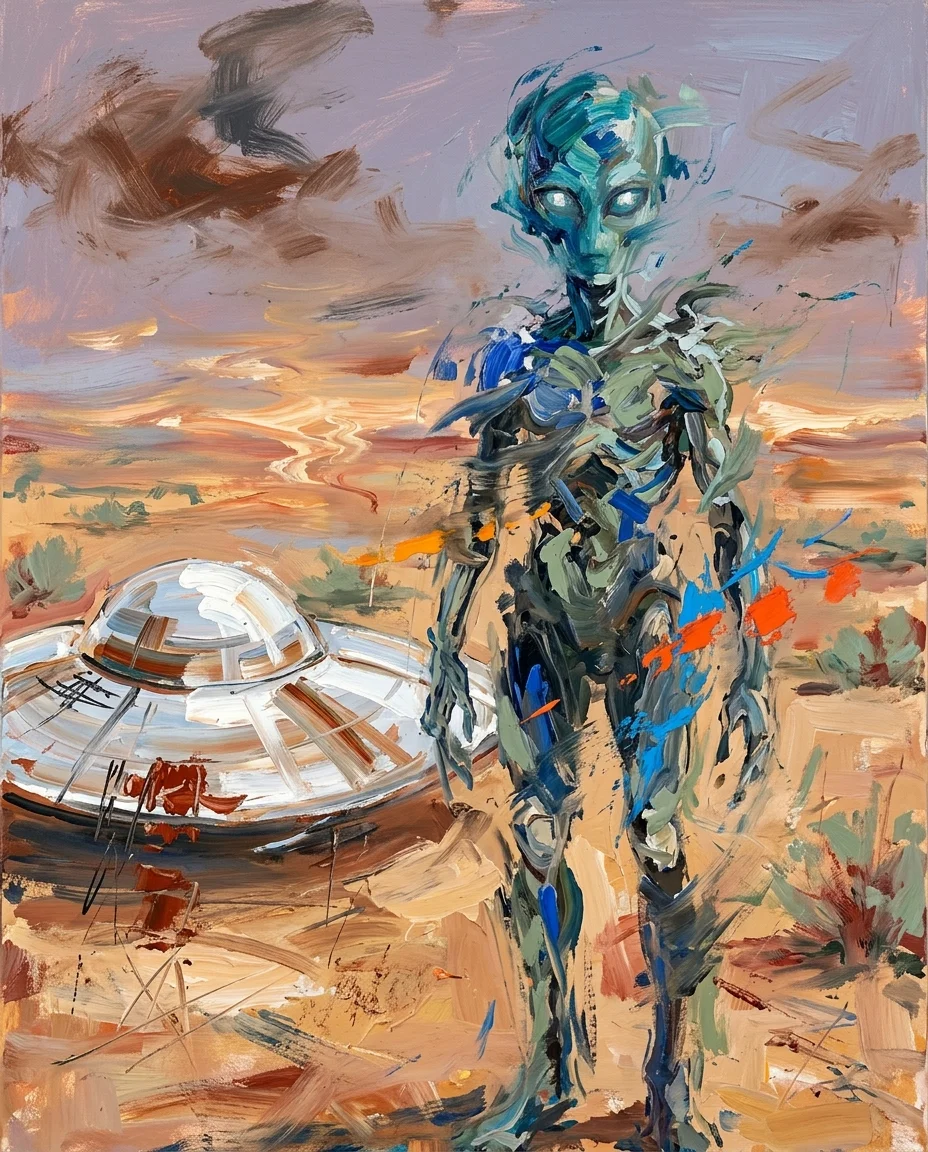
A surreal, abstracted alien figure stands tall in a vast windswept desert beside its gleaming flying saucer, rendered in an energetic gestural fragmented painterly style that oscillates between figuration and pure abstraction. The alien form towers in the center of the composition, suggested through swirling bold brushstrokes that dissolve its edges into the surrounding atmosphere — limbs and torso partially visible through layers of thick impasto paint and rapid gestural marks, its head a concentration of cerulean and sage strokes with two pale luminous eyes emerging from the chaos. The flying saucer gleams beside it with metallic reflections rendered through confident strokes of titanium white and pale silver against warm earth tones. The composition is built from sandy ochres and raw sienna desert tones, layered with muted sage greens suggesting distant scrubland and unexpected flashes of vivid cadmium orange and electric cerulean sparking through the canvas. The horizon shimmers with heat distortion — wavering horizontal strokes of warm amber and pale gold blurring ground and sky. At close viewing the alien and saucer dissolve into pure paint energy while at distance the forms coalesce into a recognizable narrative scene. Brushstrokes vary from delicate scratched lines to heavy loaded palette-knife passages. The sky is dusty mauve and pale slate with burnt umber clouds. Bold impasto style with visible thick brushstrokes and swirling textures throughout. --ar 4:5
Every prompt in this collection
A surreal, abstracted alien figure stands tall in a vast windswept desert beside its gleaming flying saucer, rendered in an...
A surreal, abstracted alien figure stands tall in a vast windswept desert beside its gleaming flying saucer, rendered in an energetic gestural fragmented painterly style that oscillates between figuration and pure abstraction. The alien form towers in the center of the composition, suggested through swirling bold brushstrokes that dissolve its edges into the surrounding atmosphere — limbs and torso partially visible through layers of thick impasto paint and rapid gestural marks, its head a concentration of cerulean and sage strokes with two pale luminous eyes emerging from the chaos. The flying saucer gleams beside it with metallic reflections rendered through confident strokes of titanium white and pale silver against warm earth tones. The composition is built from sandy ochres and raw sienna desert tones, layered with muted sage greens suggesting distant scrubland and unexpected flashes of vivid cadmium orange and electric cerulean sparking through the canvas. The horizon shimmers with heat distortion — wavering horizontal strokes of warm amber and pale gold blurring ground and sky. At close viewing the alien and saucer dissolve into pure paint energy while at distance the forms coalesce into a recognizable narrative scene. Brushstrokes vary from delicate scratched lines to heavy loaded palette-knife passages. The sky is dusty mauve and pale slate with burnt umber clouds. Bold impasto style with visible thick brushstrokes and swirling textures throughout. --ar 4:5
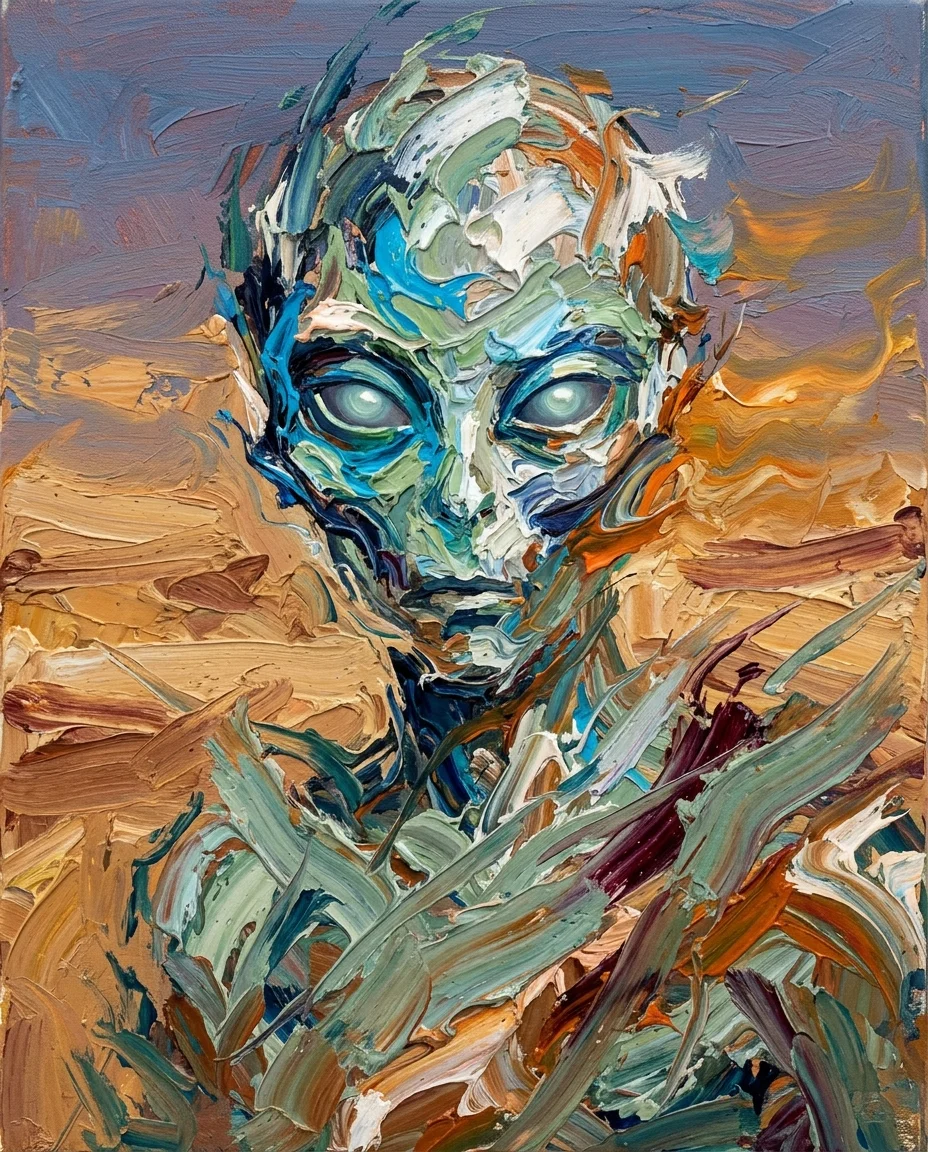
A surreal extreme close-up of the abstracted alien figure's head and upper form, filling the frame with energetic gestural painterly...
A surreal extreme close-up of the abstracted alien figure's head and upper form, filling the frame with energetic gestural painterly chaos. The alien face is suggested through concentrated layers of thick impasto paint — swirling strokes of electric cerulean, sage green, and pale titanium white converge to form two luminous pale eyes that stare outward with enigmatic otherworldly calm, the only clearly defined elements in a storm of abstracted brushwork. The head shape is implied by the concentration of cool-toned strokes against the warmer desert background — the boundary between alien and atmosphere dissolving and reforming with each viewing. Heavy palette-knife passages build the suggestion of skull structure and jawline without ever committing to literal anatomy. Below the face, the torso dissolves into even more aggressive gestural marks — rapid sweeping strokes of muted sage and raw sienna that could be shoulders or could be desert wind made visible. Flashes of vivid cadmium orange and electric cerulean spark unpredictably through the canvas. The background is the windswept desert rendered in sandy ochres and raw sienna with heat shimmer — wavering amber and pale gold horizontal strokes. The sky behind the head is dusty mauve and pale slate. The entire close-up view emphasizes the dissolution point where at this distance the alien becomes pure paint energy. Bold impasto with visible thick brushstrokes and swirling textures. --ar 4:5
A surreal wide landscape painting of a vast windswept desert with the abstracted alien figure and its gleaming flying saucer...
A surreal wide landscape painting of a vast windswept desert with the abstracted alien figure and its gleaming flying saucer appearing as small forms in the middle distance, dwarfed by the immensity of the environment. The desert stretches across the full frame — sandy ochres, raw sienna, and dry earth tones rendered in heavy textured impasto, the cracked ground a tapestry of palette-knife marks suggesting parched soil and scattered desert debris. The alien stands as a vertical concentration of cool cerulean and sage strokes beside the metallic glint of the saucer, both forms dissolving into the heat haze at this distance, more feeling than figure. The horizon line sits low in the composition, allowing the dramatic sky to dominate — layers of dusty mauve, pale slate, burnt umber clouds, and a brilliant strip of cadmium orange at the horizon suggesting the approach of something transformative. Muted sage green scrubland dots the landscape in irregular patches. The heat distortion is rendered as wavering horizontal strokes that blur the ground-sky boundary. The mood is vast, enigmatic, and profoundly lonely — the alien encounter reduced to a small bright anomaly in an indifferent landscape. Brushstrokes vary from broad sweeping gestures in the sky to delicate scratched lines in the distant scrubland. Bold impasto throughout, swirling textures, painterly atmospheric depth. --ar 4:5
A surreal painting focusing on the gleaming flying saucer resting on the desert floor, the machine rendered with more definition...
A surreal painting focusing on the gleaming flying saucer resting on the desert floor, the machine rendered with more definition than the alien figure that stands as a blurred gestural presence behind it. The saucer fills the center-lower portion of the frame — its curved metallic surface painted with confident strokes of titanium white, pale silver, and reflected warm ochre from the surrounding desert, the reflections distorted in the heat-warped air. The saucer's surface catches and bends the desert landscape in its curves — sandy earth tones and dusty sky colors reflected in sweeping metallic curves rendered through quick bold brushwork. The alien figure stands behind the saucer, reduced to a tall abstracted column of swirling cerulean, sage green, and pale strokes — even more dissolved into pure paint energy than usual, the figure oscillating entirely toward abstraction at this vantage. The desert floor around the saucer shows subtle disruption — cracked earth pushed outward in a radial pattern suggesting the impact or landing, rendered with heavy palette-knife passages. Flashes of vivid cadmium orange spark in the reflections. The sky above is dusty mauve and pale slate with swirling burnt umber clouds. The windswept desert stretches to the horizon with heat shimmer and muted sage scrubland. Bold impasto with visible thick brushstrokes, the saucer's metallic quality contrasting against the organic painterliness of everything else. --ar 4:5
A surreal painting of the abstracted alien figure walking away from the viewer and its gleaming flying saucer, moving deeper...
A surreal painting of the abstracted alien figure walking away from the viewer and its gleaming flying saucer, moving deeper into the vast windswept desert. The alien is seen from behind, its form even more dissolved than the frontal view — the back rendered as a vertical stream of swirling cerulean, sage green, and raw sienna strokes that trail upward like colored smoke, the suggestion of limbs in motion visible through the layered gestural marks. The figure grows more abstract with each step into the heat shimmer, dissolving progressively into the desert landscape. The flying saucer sits in the foreground, partially cropped at the bottom edge, its metallic surface gleaming with titanium white and pale silver reflections, serving as the solid anchor from which the alien departs. The desert stretches to a low horizon — sandy ochres, raw sienna, cracked ground rendered in palette-knife marks, muted sage scrubland. The horizon shimmers with wavering horizontal strokes of warm amber and pale gold. Vivid cadmium orange and electric cerulean flash through the figure's dissolving form. The sky above is vast — dusty mauve deepening to pale slate, burnt umber clouds drifting. The mood is melancholic and mysterious — a departure painted in the visceral language of oil paint. Bold impasto throughout with visible thick brushstrokes and swirling textures. --ar 4:5
A surreal painting at desert dusk, the abstracted alien figure and gleaming flying saucer appearing as semi-silhouettes against a blazing...
A surreal painting at desert dusk, the abstracted alien figure and gleaming flying saucer appearing as semi-silhouettes against a blazing sky of layered amber, cadmium orange, deep mauve, and burnt umber. The sky dominates the upper two-thirds of the composition, rendered in sweeping horizontal strokes of intense warm color — the sunset builds from pale gold at the horizon through vivid cadmium orange to deep dusty mauve above, the clouds rendered as heavy impasto swirls of burnt umber and slate. The alien figure stands as a dark vertical form against this spectacular sky, its edges still dissolving into gestural marks but now primarily rendered in deep cool tones — dark cerulean, deep sage, near-black strokes — the swirling abstraction creating an enigmatic dark silhouette with occasional flashes of pale luminous eyes visible within the shadow. The flying saucer beside it becomes a dark reflective disc that catches the sky colors in distorted metallic streaks — amber and mauve banding across its surface. The desert floor is plunged into shadow — deep ochre, raw umber, and warm black tones with heavy palette-knife texture. The windswept sand catches the last horizontal amber light along its ridges. The entire scene oscillates between a recognizable dusk landscape and pure expressionist color field. Bold impasto throughout with thick visible brushstrokes. --ar 4:5
A surreal painting from directly overhead looking straight down at the desert floor, where the abstracted alien figure and its...
A surreal painting from directly overhead looking straight down at the desert floor, where the abstracted alien figure and its flying saucer are represented primarily by their shadows stretching across the cracked earth. The desert surface fills the entire frame — heavy textured impasto of sandy ochres, raw sienna, and dry earth tones, the ground cracked into irregular polygonal shapes rendered with palette-knife marks in darker umber lines. The alien's shadow is the central element — a long distorted form painted in deep cool tones of cerulean, sage, and blue-black, its edges dissolving into gestural brushstrokes that blur the shadow boundary, the alien's abstracted nature carried even into the shadow it casts. Beside it, the saucer's shadow is a perfect dark ellipse — the one geometric certainty in an otherwise organic painterly composition. Scattered desert debris dots the cracked ground — small stones, dry plant matter, fragments of unknowable material near the saucer's shadow. Muted sage green suggests sparse vegetation in the cracks. Flashes of vivid cadmium orange and electric cerulean appear unexpectedly — marks of paint energy that may be reflections from above or simply the painter's assertion of color. The overhead perspective removes all horizon and sky, creating a purely terrestrial and textural composition. Bold impasto with visible thick brushstrokes and palette-knife texture throughout. --ar 4:5