Polychrome Carved Wooden Sculpture Portrait Bust
This visual collection contains 7 standalone prompts based on the same creative direction as the hero image. Copy any prompt individually or use the full set to create a consistent visual series.
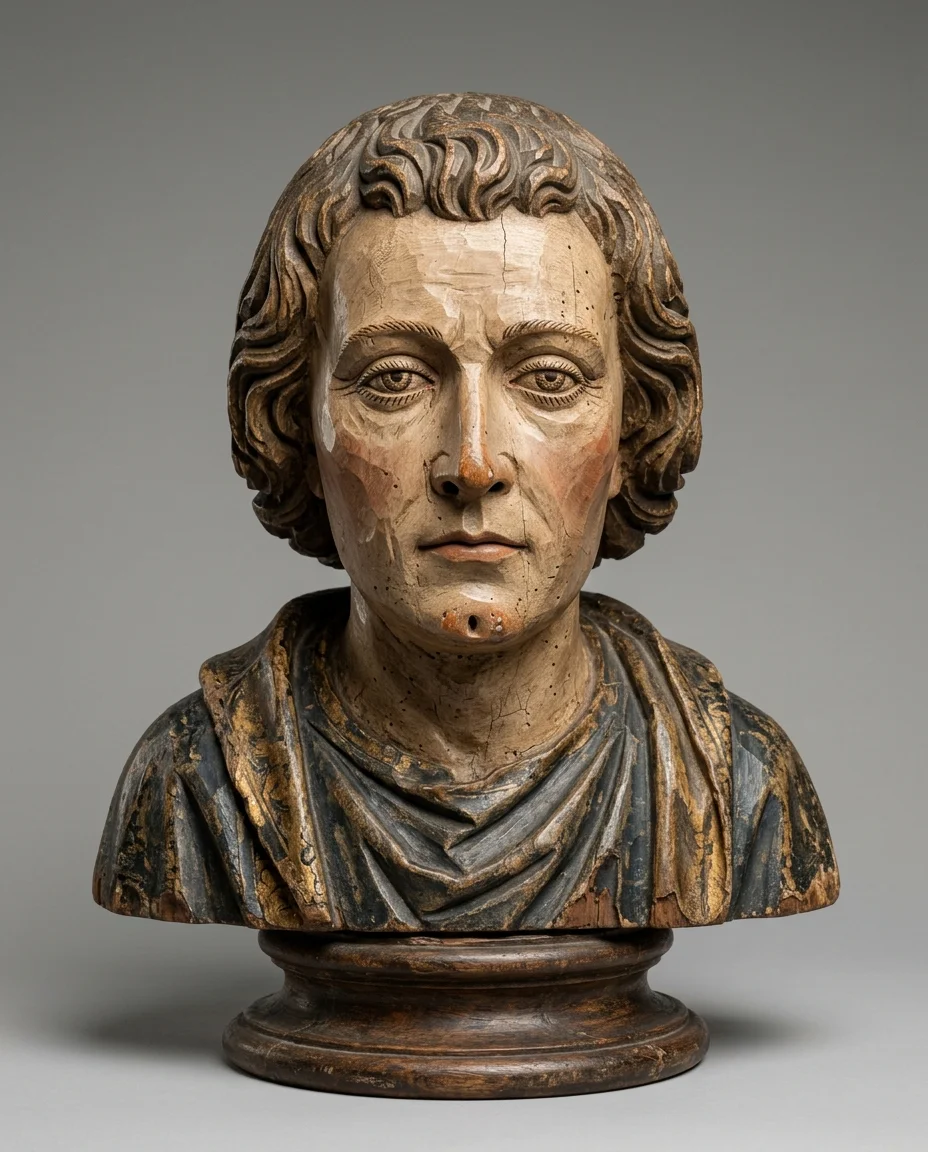
A portrait bust rendered as if carved from painted wood in the tradition of polychrome sculpture, photographed like a fine art catalog entry under controlled museum lighting. The face is no longer living skin but a matte carved surface with visible tool marks from chisel and gouge, tiny hairline cracks in the aged paint surface, subtle paint wear at the high points of the nose and cheekbones, and hardened defined edges where planes meet. The cheeks and forehead display distinct chisel planes — flattened faceted surfaces where the sculptor's tool shaped the form — with carved eyelids showing precise incised lines and sculpted nostrils with simplified geometric openings. Coloration is painted but slightly aged, warm flesh-toned pigment showing through where the surface coat has worn thin. Hair is sculpted into carved locks and grooves, thick grouped strands following simplified decorative shapes with visible chisel cuts, rigid architectural structure, no flyaways or realistic strands — purely artisan statue hair. Clothing is carved fabric with simplified bold folds, hardened stiff drapery, painted matte with slightly worn crumbling edges. Chest-up bust on a round wooden pedestal base, centered against a neutral dove-grey background. Soft museum lighting creating gentle directional shadows and subtle highlights across carved surfaces. Art catalog precision. --ar 4:5
Every prompt in this collection
A portrait bust rendered as if carved from painted wood in the tradition of polychrome sculpture, photographed like a fine...
A portrait bust rendered as if carved from painted wood in the tradition of polychrome sculpture, photographed like a fine art catalog entry under controlled museum lighting. The face is no longer living skin but a matte carved surface with visible tool marks from chisel and gouge, tiny hairline cracks in the aged paint surface, subtle paint wear at the high points of the nose and cheekbones, and hardened defined edges where planes meet. The cheeks and forehead display distinct chisel planes — flattened faceted surfaces where the sculptor's tool shaped the form — with carved eyelids showing precise incised lines and sculpted nostrils with simplified geometric openings. Coloration is painted but slightly aged, warm flesh-toned pigment showing through where the surface coat has worn thin. Hair is sculpted into carved locks and grooves, thick grouped strands following simplified decorative shapes with visible chisel cuts, rigid architectural structure, no flyaways or realistic strands — purely artisan statue hair. Clothing is carved fabric with simplified bold folds, hardened stiff drapery, painted matte with slightly worn crumbling edges. Chest-up bust on a round wooden pedestal base, centered against a neutral dove-grey background. Soft museum lighting creating gentle directional shadows and subtle highlights across carved surfaces. Art catalog precision. --ar 4:5
The same polychrome carved wooden sculpture bust photographed from a three-quarter angle, revealing the depth of the chisel work on...
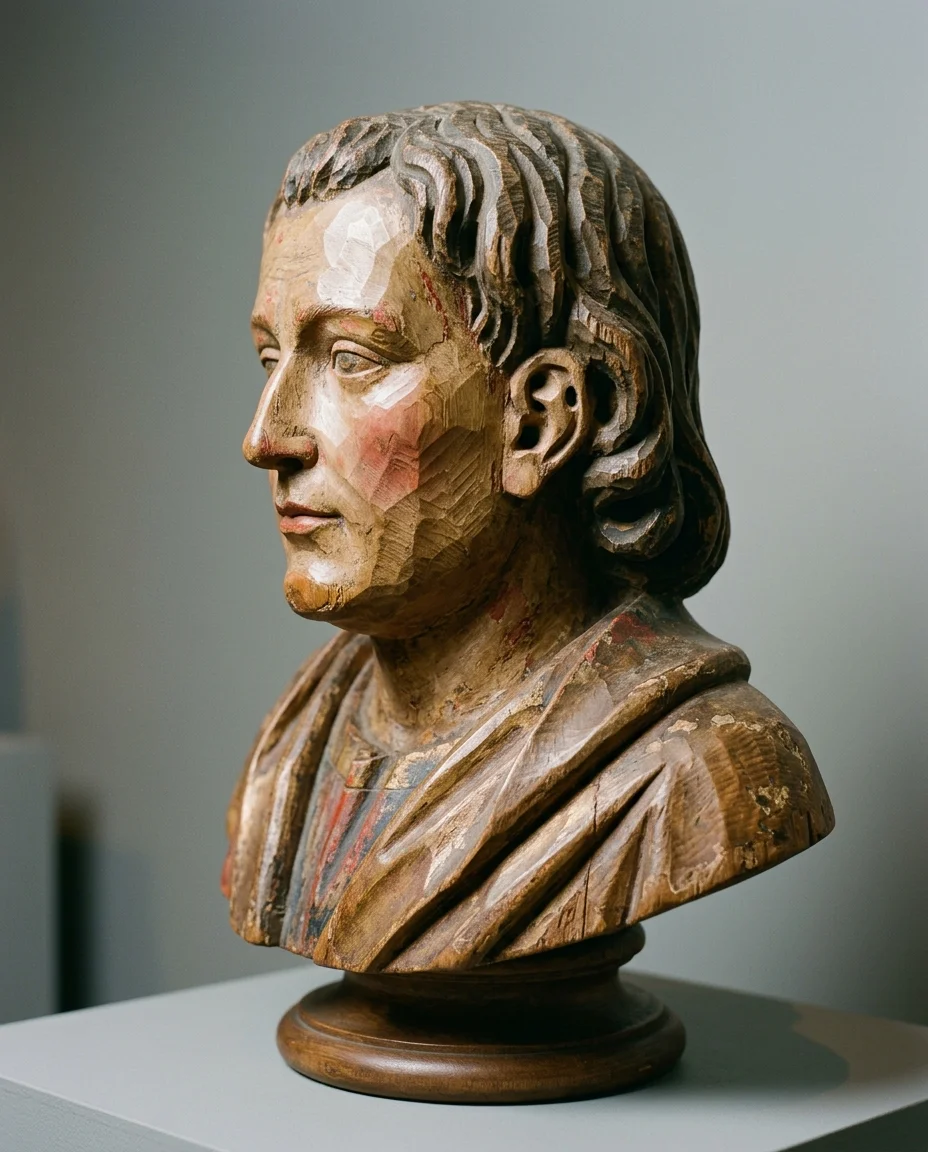
The same polychrome carved wooden sculpture bust photographed from a three-quarter angle, revealing the depth of the chisel work on the far cheek and the carved hair from the side. From this angle, the layered faceted planes of the sculptor's tool marks are dramatically visible — each cheek plane catches the museum light differently, creating a geometric map of the carving process. The hair on the near side shows deep carved grooves between the thick grouped locks, the chisel cuts creating shadow valleys that define each decorative hair group. The ear is simplified into a carved shell with geometric openings. The aging of the painted surface is more visible at this angle — chips along the jawline where the paint has flaked away revealing raw wood beneath, warm honey-colored wood grain visible in the exposed areas. The clothing folds at the shoulder show the stiff hardened drapery catching light on the high edges of each fold, the paint worn to reveal wood at the creases. The round wooden pedestal base is visible at a slight angle. Neutral dove-grey background, soft directional museum lighting from the upper left. Art catalog photography. --ar 4:5
An extreme macro close-up of the polychrome carved wooden bust's face, filling the frame from forehead to chin. At this...
An extreme macro close-up of the polychrome carved wooden bust's face, filling the frame from forehead to chin. At this magnification, the surface reads as pure sculpture — not a trace of living skin. Chisel planes across the forehead create flat geometric facets that step down toward the brow ridge. The carved eyelids show precise incised lines with a thin dark painted line defining the lash edge. The nose is simplified into faceted planes — the bridge a flat ridge, the tip a rounded but geometric form, the nostrils simplified openings carved with a small gouge. Hairline cracks in the aged paint surface create a network of fine lines across the cheeks and forehead, some following the wood grain beneath. At the high points — the bridge of the nose, the cheekbone ridges, the chin — the painted surface has worn thin, revealing warm honey-toned raw wood through the translucent remaining pigment. The warm flesh-toned paint shows subtle color variation — pinker at the cheeks, more ochre at the forehead. The matte surface absorbs the museum light without any specular shine. Art catalog macro photography, clinical precision. --ar 4:5
A pure profile view of the polychrome carved wooden sculpture bust, shot from directly to the side. The profile silhouette...
A pure profile view of the polychrome carved wooden sculpture bust, shot from directly to the side. The profile silhouette reveals the architectural structure of the carved form — the brow ridge projecting forward, the nose as a geometric protrusion with defined planes, the lips carved in simplified relief, the chin as a rounded geometric terminus. The hair structure is most impressive from this angle — thick carved locks cascading down from the crown in decorative groups, each lock a rigid shape with visible chisel cuts defining internal texture, the entire hair mass reading as an architectural element rather than organic growth. No flyaways, no softness — rigid carved wood throughout. The ear is a simplified carved shell with geometric internal structures. The clothing drapes from the shoulder in stiff folds that maintain their shape against gravity, the carved fabric edges sharp and defined. The paint surface shows its age profile — the tip of the nose worn to bare wood, crumbling edges where paint chips have fallen from carved fold edges. The round pedestal base silhouettes cleanly. Dove-grey background, museum side-lighting creating a strong shadow on the background wall. --ar 4:5
A close-up detail shot focused on the carved hair of the polychrome wooden sculpture bust, the hair section filling seventy...
A close-up detail shot focused on the carved hair of the polychrome wooden sculpture bust, the hair section filling seventy percent of the frame. The carved locks and grooves are rendered with obsessive sculptural detail — thick grouped strands following simplified decorative curves, each lock defined by deep chisel-cut valleys between the raised hair masses. The chisel marks are visible as individual tool strikes — the curved scoop of a gouge creating concave channels, the flat edge of a chisel creating sharp ridges. The paint on the hair is darker than the flesh tones — a deep warm brown with subtle auburn undertones, the paint slightly thicker in the grooves where it pooled during application, worn thinner on the raised ridge crests. Some areas show bare wood grain where the paint has worn away completely. The rigid architectural structure of the hair contrasts dramatically with the softer painted planes of the forehead and temple visible at the edge of the frame. Museum lighting creates precise shadows in every carved groove, defining the three-dimensional depth of the sculptural work. Dove-grey background. --ar 4:5
A close-up focused on the lower portion of the sculpture where the carved clothing meets the round wooden pedestal base....
A close-up focused on the lower portion of the sculpture where the carved clothing meets the round wooden pedestal base. The carved fabric shows its most dramatic fold work here — stiff drapery cascading toward the base with hardened bold folds, each fold edge sharp and geometric, the fabric valleys deep with accumulated shadow. The painted surface of the clothing shows the most wear at this junction — crumbling edges where the paint has chipped away over decades, revealing raw wood with warm honey grain visible beneath. Small paint fragments rest on the pedestal surface where they have fallen. The round pedestal base itself is turned on a lathe — visible concentric tool marks on its surface, a darker stain or varnish with its own network of fine cracks and wear. The base edge shows the dense end-grain of the wood. The junction between bust and pedestal is seamless — carved from the same block or fitted with precision, a thin dark line at the seam. Museum lighting from above creates dramatic shadows in the fabric folds and highlights the paint-loss texture. Dove-grey background, art catalog detail photography. --ar 4:5
An overhead photograph looking down at the polychrome carved wooden bust from directly above, revealing the crown of the head...
An overhead photograph looking down at the polychrome carved wooden bust from directly above, revealing the crown of the head and the hair pattern from a bird's-eye perspective. From this unusual angle, the carved hair creates a striking graphic pattern — thick locks radiating outward from a central parting point, each decorative strand group following curved paths across the scalp like a carved mandala. The chisel grooves between the hair locks create a dark network of channels. The paint on the crown is worn differently than the face — more uniform weathering from decades of dust settling, a slightly lighter patina. The forehead and the tips of the ears are visible at the edges, showing the transition from hair carving to face carving. The round pedestal base appears as a perfect circle at the bottom of the frame, the bust's profile creating a silhouette within it. The dove-grey background creates a clean surround. Museum lighting from above creates minimal shadow from this angle, instead revealing the subtle topography of the carved surface through gentle tonal variation. Art catalog overhead photography. --ar 4:5