Hyper-Realistic Origami Sculpture on Minimalist Table
This visual collection contains 7 standalone prompts based on the same creative direction as the hero image. Copy any prompt individually or use the full set to create a consistent visual series.
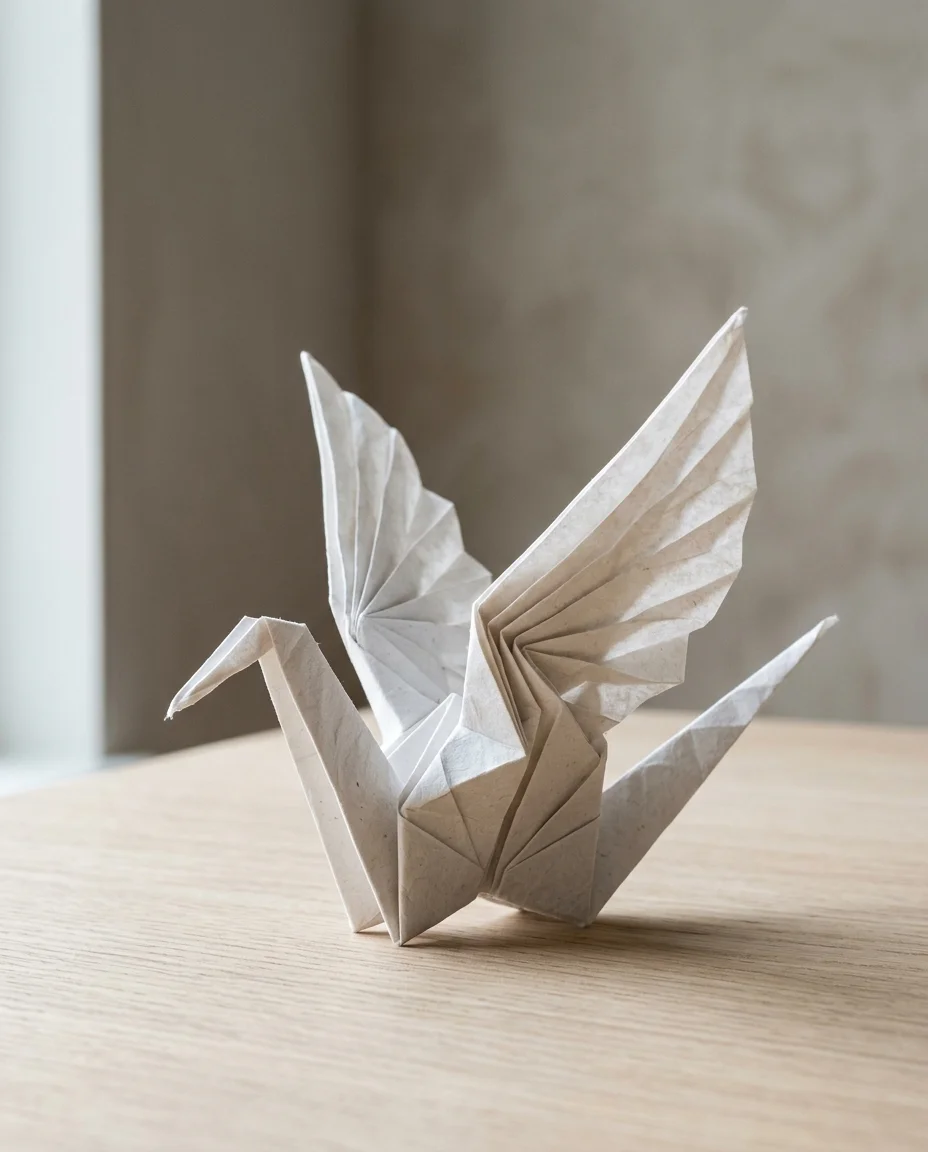
A hyper-realistic close-up photograph of a stunning origami crane sculpture crafted from intricately folded white paper, displayed on a minimalist pale oak table against a clean warm-grey wall. The crane is rendered with extremely detailed and precise folds — every crease sharp and deliberate with crisp geometric edges that catch the light. The wings are spread in a graceful arc, each wing surface showing multiple triangular facets where fold lines create angular planes. Subtle shadows pool in every fold valley, revealing the three-dimensional complexity. The paper texture shows extraordinary fidelity — visible individual fibers running through the material and slight translucency where the paper thins at fold points, allowing diffused light to glow faintly through layered sections. Soft natural window light enters from the left side, casting gentle dramatic shadows from the wing tips and tail that stretch across the pale oak surface. Warm highlights catch on the paper ridges while cool shadow fills the interior folds. The composition places the sculpture as the clear focal point with generous negative space around it. The overall mood is serene and contemplative, the pale oak table and clean wall providing breathing room. Ultra-detailed photorealistic paper art quality where every micro-fold and fiber is visible. --ar 4:5
Every prompt in this collection
A hyper-realistic close-up photograph of a stunning origami crane sculpture crafted from intricately folded white paper, displayed on a minimalist...
A hyper-realistic close-up photograph of a stunning origami crane sculpture crafted from intricately folded white paper, displayed on a minimalist pale oak table against a clean warm-grey wall. The crane is rendered with extremely detailed and precise folds — every crease sharp and deliberate with crisp geometric edges that catch the light. The wings are spread in a graceful arc, each wing surface showing multiple triangular facets where fold lines create angular planes. Subtle shadows pool in every fold valley, revealing the three-dimensional complexity. The paper texture shows extraordinary fidelity — visible individual fibers running through the material and slight translucency where the paper thins at fold points, allowing diffused light to glow faintly through layered sections. Soft natural window light enters from the left side, casting gentle dramatic shadows from the wing tips and tail that stretch across the pale oak surface. Warm highlights catch on the paper ridges while cool shadow fills the interior folds. The composition places the sculpture as the clear focal point with generous negative space around it. The overall mood is serene and contemplative, the pale oak table and clean wall providing breathing room. Ultra-detailed photorealistic paper art quality where every micro-fold and fiber is visible. --ar 4:5
An extreme macro photograph of a single fold intersection on the origami sculpture where three creased edges meet at a...
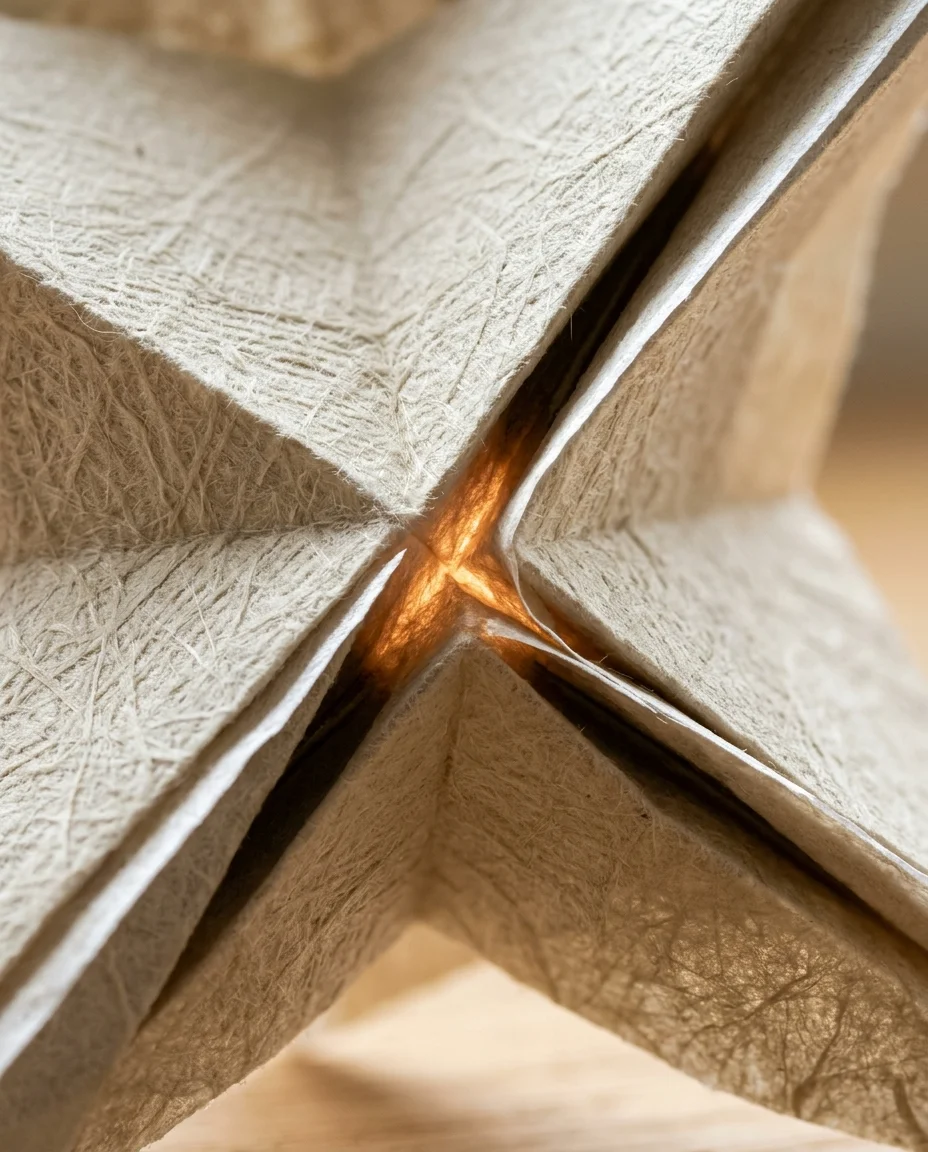
An extreme macro photograph of a single fold intersection on the origami sculpture where three creased edges meet at a point. At this scale, the paper becomes a landscape — visible individual cellulose fibers running in parallel like tiny threads across the surface, the matte texture of the paper showing subtle variations in density and color. At the fold point where the three creases converge, the paper has been compressed to its thinnest, creating a translucent zone where soft window light passes through from behind, glowing with a warm amber quality as the light filters through the layered paper material. The three fold lines extending from the central point are sharp mountain folds — the paper rising to crisp ridges that cast precise linear shadows on the adjacent flat surfaces. Where the folds create overlapping layers, the paper edge thickness is visible — approximately half a millimeter of card stock catching light as a bright white line at each layer boundary. The shadows within the fold valleys transition from warm where light reflects off adjacent paper surfaces to cool grey in the deepest recesses. The pale oak table surface is visible as a blurred warm tone at the frame edges. The macro detail is obsessive, capturing every fiber strand and shadow gradient. --ar 4:5
The origami sculpture backlit by a window directly behind it on the minimalist pale oak table....
A hyper-realistic photograph of the origami sculpture backlit by a window directly behind it on the minimalist pale oak table. The window light passes through the paper, transforming the sculpture into a luminous lantern — every thin fold point glows with warm amber-white light filtering through the translucent paper, while thicker multi-layered sections remain more opaque, creating a gradient map of the paper's structural thickness across the entire form. The sculpture's front-facing surfaces are in relative shadow, the crisp fold edges visible as dark geometric lines against the glowing paper behind. The silhouette is dramatic — the angular origami form outlined against the bright window creates a strong graphic shape. On the pale oak table surface in front of the sculpture, the transmitted light casts a soft warm glow, and the sculpture's shadow is surprisingly detailed — each fold edge projects as a thin dark line within the softer overall shadow. The window itself is slightly overexposed, a bright rectangle of warm light. The clean warm-grey wall is visible on either side of the window. The overall effect transforms a paper sculpture into an architectural light study, revealing structure through luminosity. --ar 4:5
A hyper-realistic top-down photograph looking directly down at the origami sculpture on the pale oak table surface. From above, the...
A hyper-realistic top-down photograph looking directly down at the origami sculpture on the pale oak table surface. From above, the intricate fold pattern is revealed as a geometric composition — the angular planes of the wings, body, and tail create a complex tessellation of triangular and diamond-shaped facets, each plane at a slightly different angle to the overhead camera, catching light at different intensities. The sculpture reads almost as a geometric abstract artwork from this perspective — a pattern of light and shadow created by the three-dimensional fold angles projected flat. The paper texture is visible across every facet surface — individual fibers, slight color variations in the white paper, and the precise crease lines as dark geometric boundaries between each plane. The pale oak table surface surrounds the sculpture with generous space, showing its natural grain pattern that provides a warm, organic contrast to the geometric precision of the paper. Soft overhead window light creates even illumination with subtle shadows falling into the fold valleys visible as dark lines between the bright paper planes. The composition is centered and symmetrical, emphasizing the mathematical precision of the origami construction. --ar 4:5
The origami sculpture in late afternoon light where the sun enters from a low angle through...
A hyper-realistic photograph of the origami sculpture in late afternoon light where the sun enters from a low angle through the side window, casting long dramatic shadows from every fold edge across the pale oak table surface. The sculpture itself is warmly lit on one side — the paper catching rich amber-gold light that emphasizes the cellulose fiber texture and turns the white paper into warm cream. The opposite side falls into cool blue shadow. But the star of this composition is the shadow — the fold geometry projects an intricate pattern of dark angular lines and shapes onto the oak surface, stretching three to four times longer than the sculpture itself. Each fold edge creates its own distinct shadow line, and where multiple folds overlap, the shadow darkens into deeper tones. The shadow pattern is a deconstructed version of the sculpture's three-dimensional form — revealing its geometric complexity as a flat projection. The pale oak surface catches the amber light warmly, with the grain pattern visible beneath the shadow lines. The clean warm-grey wall behind catches the warm light at the base and transitions to neutral above. The mood is contemplative and golden. --ar 4:5
Three different origami sculptures arranged in a deliberate row on the minimalist pale oak table against...
A hyper-realistic photograph of three different origami sculptures arranged in a deliberate row on the minimalist pale oak table against the clean warm-grey wall. From left to right: a simple traditional crane with clean elegant folds, a moderately complex lotus flower with layered petal folds opening upward, and an intricate modular sphere constructed from dozens of interlocking folded units creating a geometric polyhedron. Each sculpture is crafted from the same white paper stock, creating a unified material palette while the increasing complexity tells a progression story from simple to extraordinary. Soft natural window light from the left creates consistent directional shadows that stretch to the right from all three forms. Each sculpture's paper texture shows the same extraordinary detail — visible fibers, translucent fold points, and crisp crease geometry. The spacing between sculptures is generous and deliberate, allowing each form to breathe on the pale oak surface. The composition suggests a curated gallery display — three works in ascending complexity, unified by material, differentiated by ambition. The mood is contemplative and appreciative of the range of paper folding artistry. --ar 4:5
A hyper-realistic photograph on the pale oak table showing the origami creation process — a finished origami sculpture positioned in...
A hyper-realistic photograph on the pale oak table showing the origami creation process — a finished origami sculpture positioned in the right portion of the frame, with a partially folded sheet of the same white paper in the left portion at an earlier stage of the folding process. The partially folded paper shows the intermediate state — some crease lines already pressed into the sheet creating a geometric grid pattern, one corner folded inward with a precise diagonal crease, the paper transitioning from flat to three-dimensional at this halfway point. The pre-fold crease lines are visible as subtle indentations in the flat paper surface, mapping out the complete fold pattern like architectural blueprints. Beside the partially folded paper, a single completely flat sheet of the same white paper stock lies pristine with no folds — showing the raw material. The three stages — flat sheet, mid-fold, finished sculpture — tell the complete transformation story from left to right. Soft natural window light from the side creates consistent shadows across all three states. The pale oak table surface and clean wall provide the minimalist backdrop. The paper texture is consistently detailed across all three stages. --ar 4:5